
Service
Get the First Few Months Right
Everything your puppy learns in the next twelve weeks, they will believe for the rest of their life. Worth getting right.
In short
Puppy training should start the day your puppy comes home, not at six months when something has already gone wrong. Between roughly 3 and 16 weeks of age a puppy is building the templates it will use for life — what is safe, what is worth reacting to, and who is worth listening to. Get that window right and most of the problems people call trainers about later simply never form.
Sound familiar?
Sound familiar?
- Needle teeth on hands, ankles and the kids — constantly
- Toilet training that is nearly there and then suddenly is not
- Screaming the house down the moment they are left alone
- Already pulling, already barking, already running the show
- Not sure how to socialise safely before the vaccinations are done
- Getting completely contradictory advice from the internet
How it works
How it works
Set the house up properly
Where the crate goes, where the bed goes, what the routine looks like, what everyone in the house is and is not allowed to do. Half of puppy training is environment, and it is the half nobody tells you about.
Fix the three things that drive owners mad
Biting, toileting and settling. We work on all three in the session, with technique you can actually apply at 11pm on a Tuesday when you are exhausted.
Build a socialisation plan
Not "meet as many dogs as possible" — that advice ruins puppies. A structured list of what to expose them to, in what order, and how to read whether it is going well.
Start the real training
Name response, loose lead from the first walk, sit and drop, and the beginnings of recall. Started now, these are easy. Started at ten months, they are work.
Inside the process
What actually happens
Most puppy problems are not behaviour problems. They are timing problems. Something that would take ten minutes to shape at nine weeks takes six months to undo at nine months, and the only difference is when someone stepped in.
So the session starts with your house. Where is the puppy sleeping, and is that working? Where do they go when everyone leaves? What happens when they cry — and who in the house cracks first? Is the crate a safe place or a punishment box? None of this is glamorous, but the environment is doing more training than any command you will ever teach.
Then we tackle the big three, because these are the ones that make people cry in the first month. Biting: puppies bite, it is normal, and there is a right way to teach bite inhibition that does not involve yelping like a stricken bird or holding their mouth shut. Toileting: it is a routine and a supervision problem, not an intelligence problem. Settling: a puppy that cannot switch off is not naughty, it is overtired, and the fix is usually more sleep rather than more exercise.
Socialisation gets its own section because it is the part most people get badly wrong. The goal is not for your puppy to meet a hundred dogs. It is for your puppy to see a hundred things — bikes, wheelie bins, hi-vis vests, the beach, tiled floors, umbrellas, kids on scooters — and learn that none of them are a problem. One bad experience with a rude adult dog at ten weeks can create a reactive dog at ten months. We build a plan that gets you exposure without the risk.
And then we start actual training, which at this age is mostly play. Puppies learn fast when it is fun, and everything we teach now is a deposit against adolescence — which is coming, whether you are ready or not.
What you actually get
What a puppy training session actually involves
- Where
- Your home — where the puppy actually lives
- Format
- One-on-one, at the puppy's pace
- From what age
- Eight weeks. The day it comes home is the right day
- How long
- One hour — we fix one thing properly rather than everything badly
What’s included
- A full review of your home setup — where the crate goes, where the bed goes, what the day looks like
- Biting and mouthing: technique that works at 11pm when everyone is exhausted
- A toilet training routine built around your actual working hours
- Settling and alone-time foundations, which is the bit that prevents separation problems later
- A socialisation list for the critical window, worked through with you — surfaces, sounds, sights, places, handling, rather than "socialise him"
- Name response, loose lead from the first walk, and the beginnings of recall
- Age-appropriate jobs for the kids so they are part of the solution
- One thing to practise before the next session, not a list of ten
- Follow-up support through the first months
What’s not included
- Vaccination or health advice — talk to your vet, and I will build the plan around what they say
- Puppy-class-style group play. If your puppy needs structured puppy contact I will point you at a class
- Any promise about how your puppy will turn out. Genetics and the breeder's first eight weeks are already in the mix
- Breeder selection or puppy-buying advice after the fact
What I need from you
- The whole household, including children old enough to follow an instruction
- Honesty about your hours — a plan built for a household that is home all day is useless if you work full-time
- Whatever your puppy is currently eating, so we can use some of it
- Your vet's advice on local disease risk before we finalise the socialisation plan
- A willingness to enforce sleep. It is the single most common thing owners resist and the single most effective thing they can do
After the session
What happens once I leave
Puppy work has a longer tail than most services, because the puppy keeps changing under you. What is true at ten weeks is not true at sixteen, and what is true at sixteen weeks falls apart at ten months.
We work the immediate thing first — usually biting or toileting, whichever is making your life hardest — and the socialisation list gets walked through with you so it stops being a vague instruction and becomes something specific: surfaces, sounds, sights, places, handling. Puppies are the one case where the window genuinely matters, so that gets covered early even though everything else is staged.
Follow-up support through the first months matters more here than in any other service. The questions arrive on a schedule. Week two is usually toileting. Week four is biting escalating rather than fading, which is nearly always a sleep problem. Somewhere around four months the teething makes everything worse again. And at eight to ten months adolescence arrives and a lot of owners conclude the training failed.
It did not. That is a developmental stage and it is survivable if you hold the rules through it, which is exactly the moment most people stop. Knowing it is coming is most of the battle, which is why it is in the plan from the start rather than sprung on you later.
The difference
Why this works where other things haven't
The usual approach
- Four weeks of puppy preschool, then you are on your own
- Off-lead free-for-all play billed as "socialisation"
- A handout about toileting and a bag of treats
- Everything taught in a clinic waiting room at 6pm
- No help with the actual 3am problems
How I work
- In your home, where the puppy actually lives
- Structured exposure with a plan, not a puppy mosh pit
- Routines built around your household and your work hours
- Biting, toileting and separation dealt with directly
- Support through the first months, not just the first fortnight
What changes
What changes
- A puppy that settles on their own instead of demanding attention
- Toileting sorted with a routine, not a mop
- Soft mouth — play without the punctures
- Confident around traffic, bikes, kids, other dogs and the vacuum
- Alone time that is boring instead of terrifying
- A foundation that holds through adolescence, when most dogs fall apart
Expected outcomes
What you'll notice, and roughly when
Inside the first week you should see the biting change. Not stop — puppies bite, that is the job description — but soften noticeably, and become interruptible. That alone transforms how a family feels about a new puppy.
Toileting usually tightens up within a fortnight once the routine is running properly and someone is actually watching for the signals. The accidents that remain tend to be supervision lapses rather than confusion, and those are easy to fix.
Settling is the one owners underestimate and then rate the highest afterwards. A puppy that can take itself to bed and switch off changes the entire household. It is also the single best predictor of whether that dog will develop separation problems later, which is why it gets attention early rather than being left to sort itself out.
The real payoff arrives at eight to eighteen months, when adolescence hits and your friends' dogs start becoming difficult. That is when the foundation either holds or it does not. A puppy that has learned to settle, to check in with you, to walk on a loose lead and to think of the world as basically safe will wobble during adolescence. A puppy that has not will have a crisis. That is what this work is really buying you.
Being straight with you
What this won't do
A few honest limits worth knowing before you book.
The window is real and it is closing. Between roughly three and sixteen weeks a puppy is building its template for what is normal. After that, everything is still possible but it takes longer and needs more care. If your puppy is already six months old, this is still worth doing — just do not let anyone tell you it is the same job.
I cannot undo the first eight weeks. What happened at the breeder or in the litter is already in the dog. A well-raised litter gives you an enormous head start; a puppy from a poor start may need behaviour work rather than puppy training, and I will tell you if that is what I am looking at.
Genetics are in the mix. Temperament is not infinitely malleable. A genetically nervous puppy can be given every advantage and still be a cautious adult. That dog can live an excellent life — but I am not going to promise you a bombproof one.
And puppy school is not a competitor. If what your puppy most needs is structured contact with other puppies, go to a class, and I will say so. The two do different jobs and plenty of households should do both.
Who this is for
Is this the right fit?
If you recognise yourself in this list, we should talk.
- New puppies from 8 weeks — the earlier the better
- First-time owners who want to not stuff it up
- Families with young kids and a puppy that bites
- Second-dog households sorting out the dynamic early
- Anyone who has had a difficult dog before and does not want a repeat
Suburb-specific
Puppy Training in your suburb
Local guides for the suburbs where this comes up most.
City of Onkaparinga
Puppy Training in Noarlunga
The estuary, the Coast Park path and Colonnades. Great socialisation country if you use it deliberately.
Read the Noarlunga guideCity of Victor Harbor
Puppy Training in Victor Harbor
Local one-on-one behaviour help, without the ninety-minute drive to Adelaide and back.
Read the Victor Harbor guideWhere I work
Puppy Training across southern Adelaide
I travel in-home from the Adelaide CBD south through to Victor Harbor.
 27 suburbs
Adelaide's Inner South
Small blocks, shared fences and footpaths full of people. The inner south asks a lot of a dog.
Dog training in Inner South 26 suburbs
The Southern Beaches
Beach walks, esplanade crowds and off-lead hours that catch people out. Recall matters more here than anywhere.
Dog training in Southern Beaches 35 suburbs
Adelaide's Southern Suburbs
The heartland. Close-set housing, shared fences, and more council barking complaints than anywhere else I work.
Dog training in Southern Suburbs 22 suburbs
The Southern Vales
Vines, acreage and one of the best dog beaches in the state. Different geography, different problems.
Dog training in Southern Vales 25 suburbs
The Fleurieu & Victor Harbor
Hardest part of the state to find proper behaviour help. That is exactly why I come down here.
Dog training in FleurieuReal owners
Owners I've worked with on puppy training
After just 1 session with The Dog Obedience Guy I could already see improvement with Sammi. Today I walked both dogs, side by side with ease continuing the strategies I learnt. Thanks, one very happy customer
Have just finished our last session and I was given excellent help and ideas. Turns out it wasn't Ollie (it was me) 🤣 Thank you for all the help. Ollie loved it. Would definitely recommend. Thanks Faz
Often comes up alongside
Related services
These are the ones people working on this most often need to look at too.
Dog Obedience Training
Your dog already knows "sit". The question is whether they do it when a magpie lands on the fence.
Learn moreIn-Home Dog Training
Your dog does not misbehave in a training hall. It misbehaves at your front door. So that is where we work.
Learn moreSeparation Anxiety
The neighbours have mentioned the howling. The door frame is destroyed. Your dog is not being naughty — it is genuinely panicking.
Learn moreRead more
Obedience & Training
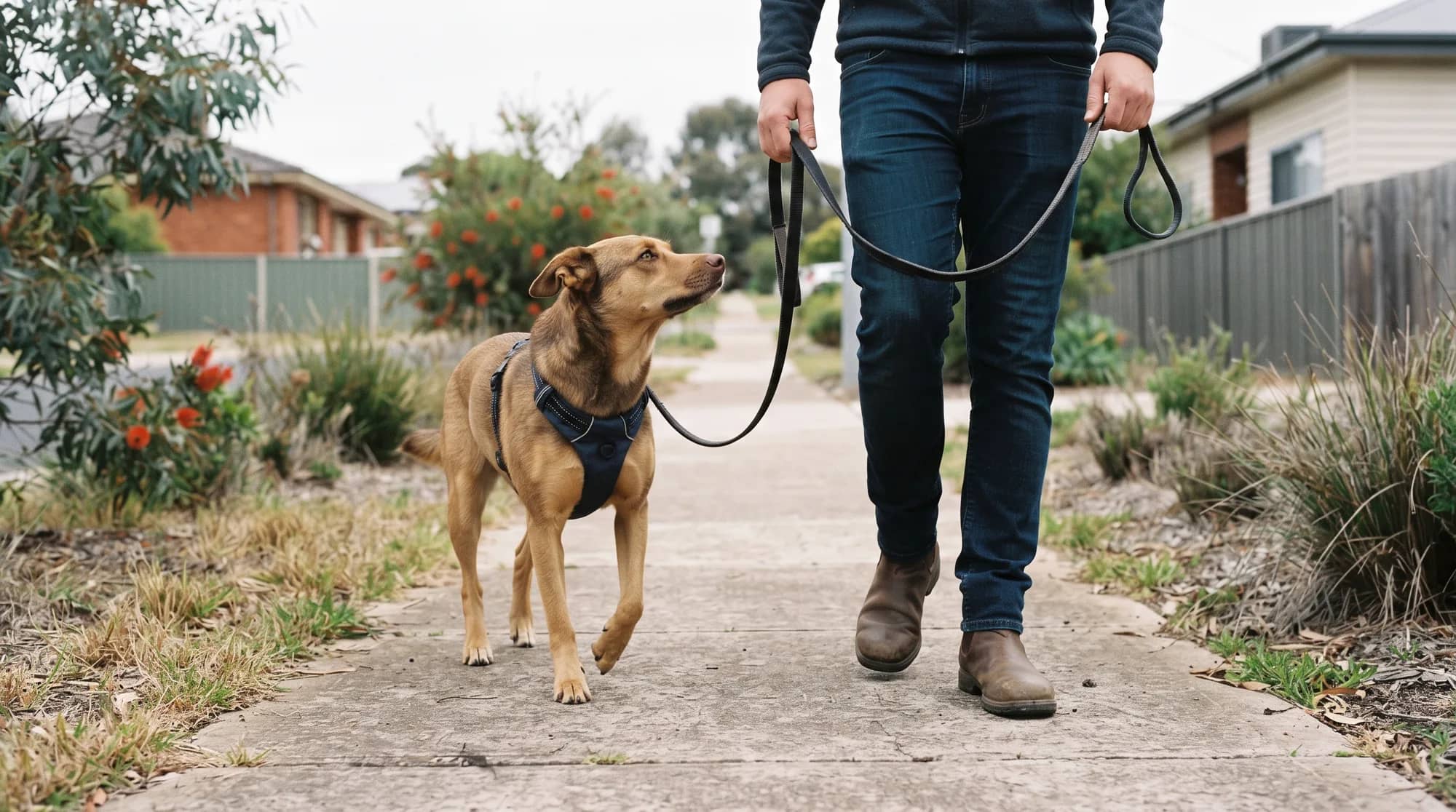
How to Stop Your Dog Pulling on the Lead
Your dog is not pulling because it is dominant, stubborn, or untrained. It is pulling because pulling works — and it has worked every single walk since the day you got it.
Puppy Training
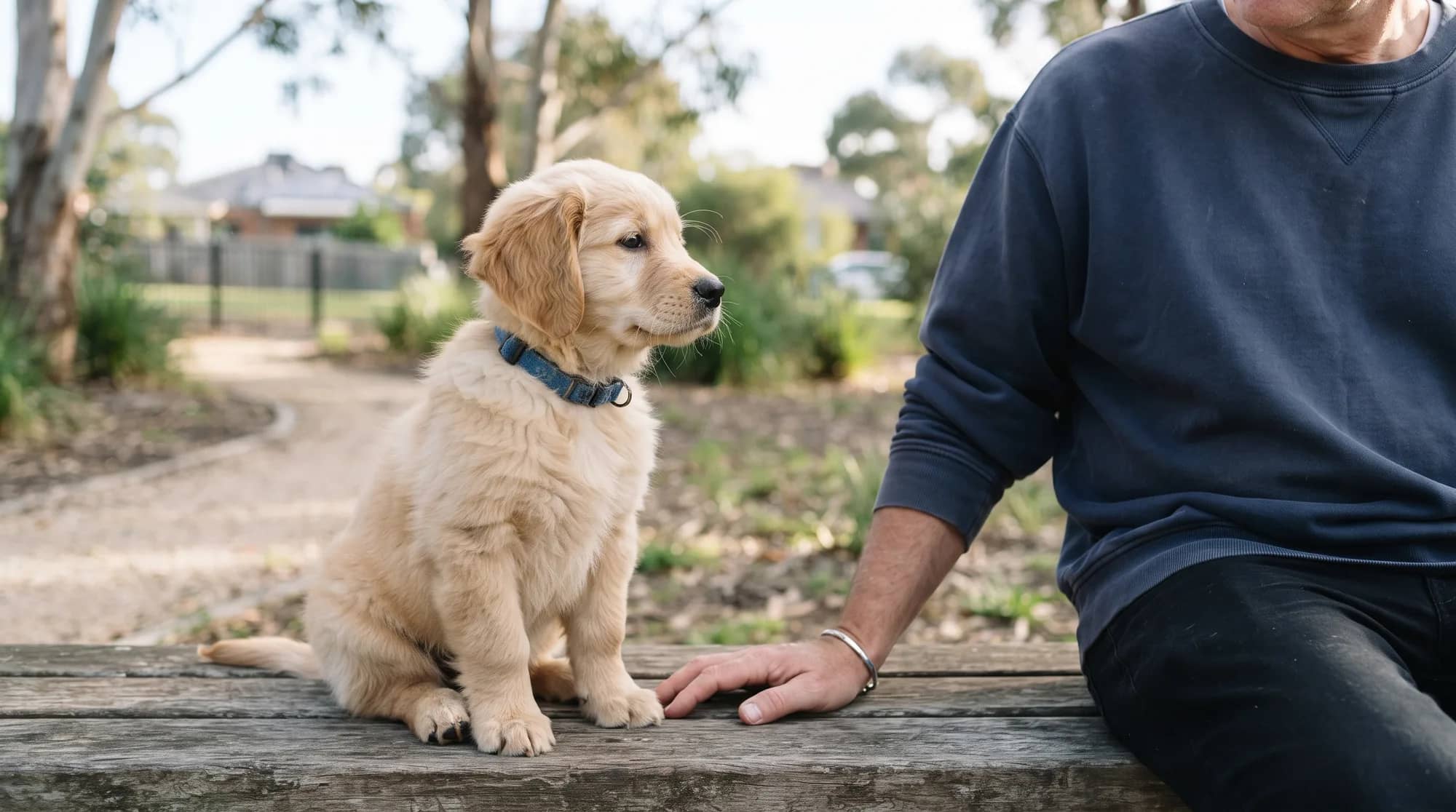
When Should Puppy Training Actually Start?
The most valuable training window in your dog's entire life closes at around sixteen weeks. Most people start using it at six months.
Puppy Training
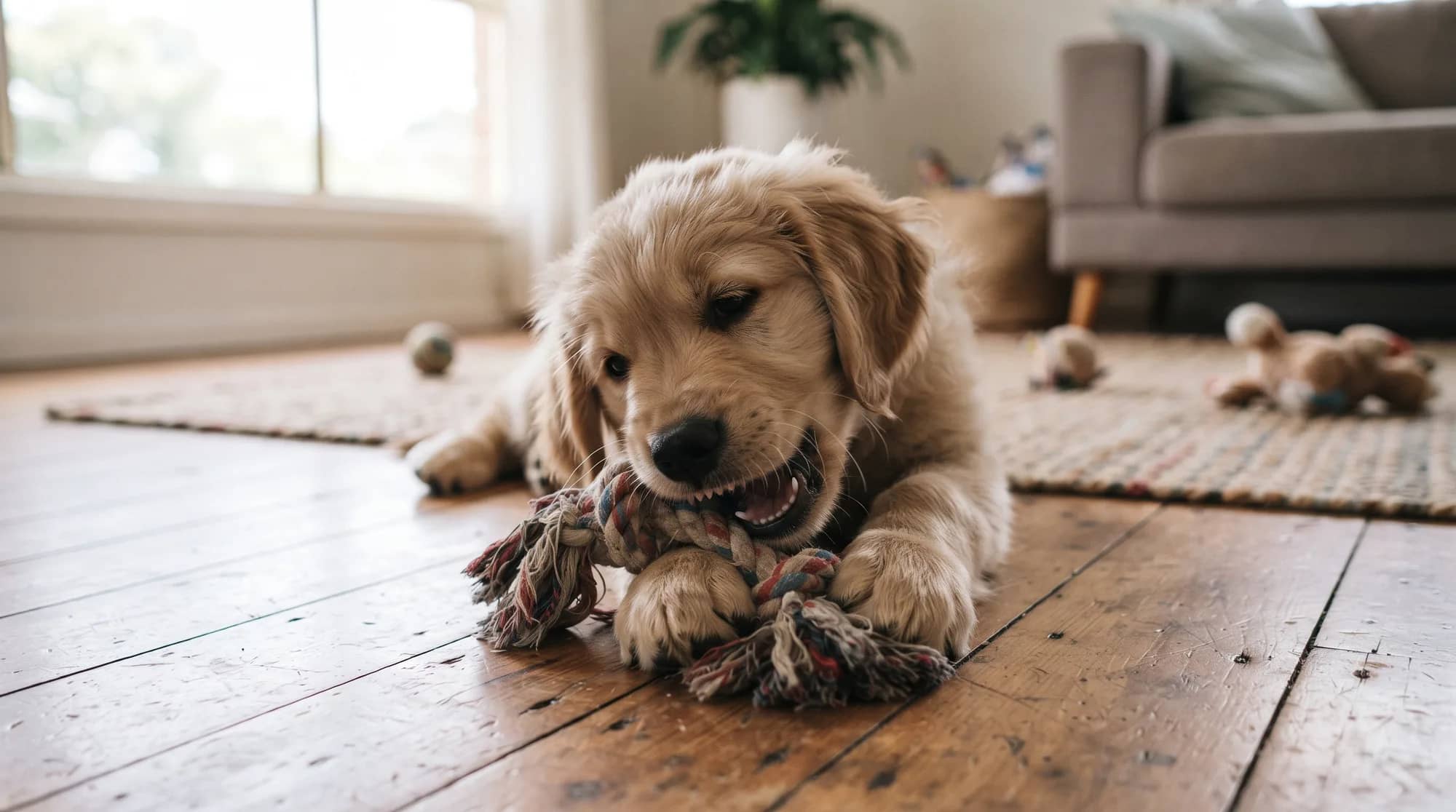
Puppy Biting: Why It Happens and How to Stop It
Your hands look like you lost a fight with a blender. This is normal, it is developmentally necessary, and it does end — faster if you handle it well.
Local pages
Puppy Training near you
Same service, written for the suburb — the council, the parks and the problems that come up there.
Read up
Free guides on puppy training
Written for owners in southern Adelaide. If one of these sorts your problem out and you never ring me, that is a good outcome.
Puppy Training
When Should Puppy Training Actually Start?
The most valuable training window in your dog's entire life closes at around sixteen weeks. Most people start using it at six months.
Puppy Training
Puppy Biting: Why It Happens and How to Stop It
Your hands look like you lost a fight with a blender. This is normal, it is developmentally necessary, and it does end — faster if you handle it well.
Questions
Puppy Training — your questions
How old should my puppy be before we start?
My puppy has not had all its vaccinations. Can we still socialise?
Should I do this instead of puppy preschool?
Is a crate cruel?
We got a rescue puppy with an unknown history. Does that change things?
Ready when you are
Let's sort your dog out.
Tell me what's going on and I'll tell you straight whether I can help — and roughly what it will take. No obligation, no pressure. Southern suburbs of Adelaide — CBD to Victor Harbor.
Send a quick enquiry
Four things and I’ll come back to you. If it is urgent, ring instead — that is always faster.