Your dog is not pulling because it is dominant. It is not pulling because it is stubborn, or because it hasn't been "shown who's boss", or because you got the wrong breed.
It is pulling because pulling works.
Every single walk, your dog has leaned into the lead and the world has moved towards it. Lamppost, bin, other dog, interesting patch of grass — lean forward, and it arrives. That has happened thousands of times. From your dog's point of view, this is the most reliably rewarded behaviour in its entire life.
Which is good news, actually. A behaviour that is being maintained by a consequence can be changed by changing the consequence. It just requires you to be more patient than the dog is, for about a fortnight.
Why the equipment doesn't fix it
I get asked about no-pull harnesses and head halters constantly, so let me be straight about them.
They work, in the narrow sense that a front-clip harness makes it physically harder for your dog to drag you and a head halter gives you steering. That is genuinely useful, particularly if you have a big dog and a bad shoulder. Management matters.
But nothing about wearing a harness teaches your dog that a loose lead is worth having. The moment the equipment comes off — or the moment your dog gets used to it, which most do — you are back where you started. Equipment buys you control while you train. It is not the training.
The other thing worth knowing is that a badly fitted head halter is genuinely unpleasant for a dog, and dogs that hate them tend to spend the whole walk trying to rub them off rather than learning anything. If you use one, get the fit checked and spend a week conditioning your dog to it properly before you walk anywhere.
The thing nobody tells you about walks
Here is the mental shift that makes this work: for the next two weeks, walks are not exercise.
This is the bit people struggle with, and I understand why. You have a dog that needs a run and you have twenty minutes. But if you spend those twenty minutes covering three kilometres while your dog tows you, you have just done twenty more minutes of pulling practice.
So for a fortnight, walks become training sessions. You might cover two hundred metres. That is fine. Meet the exercise need some other way — a long line in an open reserve, a game in the yard, some scentwork, a play session. Sniffing is genuinely tiring for a dog; ten minutes of nose work in a park does more than a kilometre of trotting.
Once the lead skill is solid, the walks come back. But you cannot train a loose lead and get your steps in at the same time, and trying to do both is why most people fail at this.
The method
Step one: decide what the lead should feel like
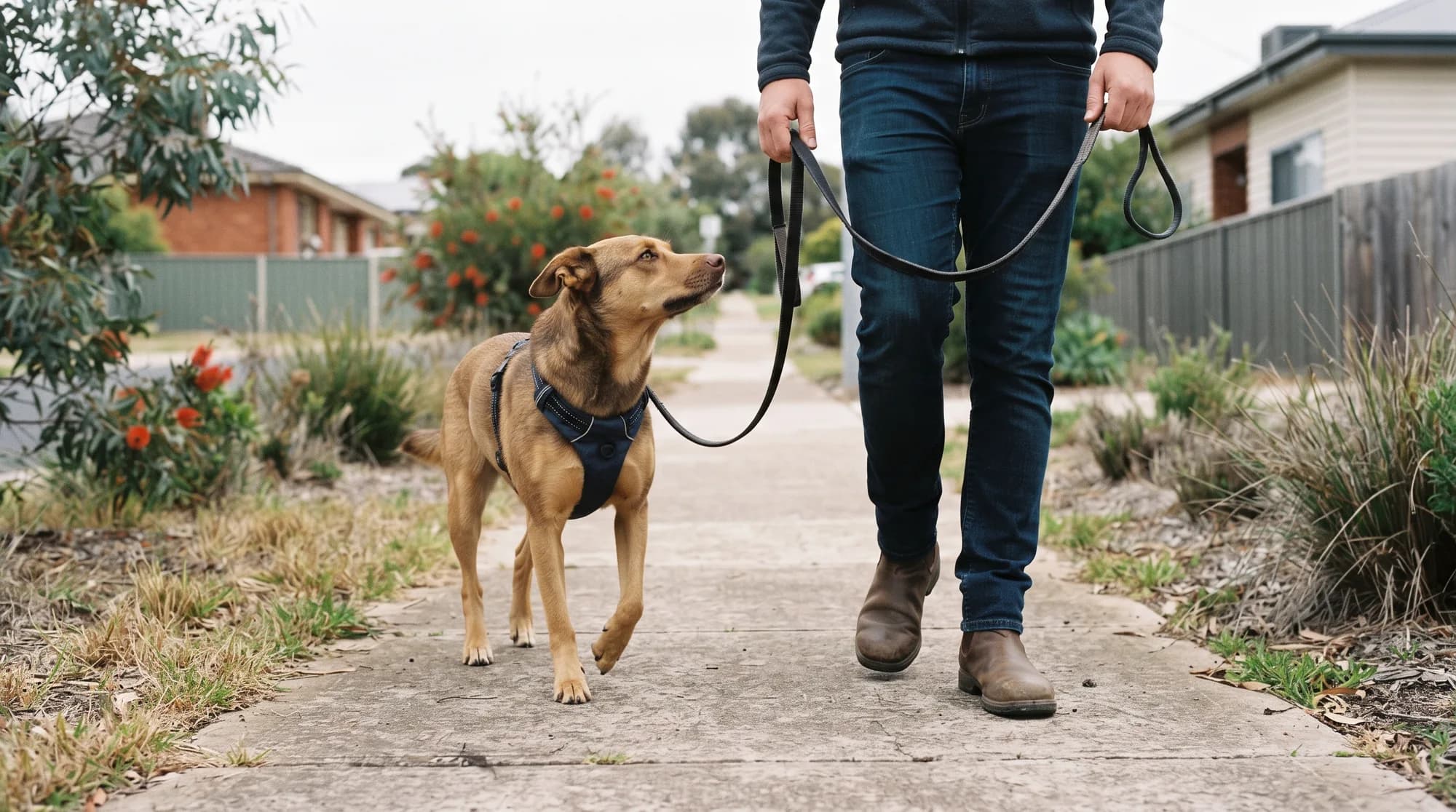
Pick a position. It does not have to be a competition heel with your dog's shoulder at your knee — for most people, "somewhere beside or slightly ahead of me, with slack in the lead" is the goal. Whatever you pick, everybody in the house has to use the same one.
Hold the lead in a way you can sustain. Wrapped around your hand, arm at your side, roughly at your hip. Not extended out in front of you like you are walking a kite.
Step two: the lead going tight ends the walk
Not permanently. Just for that moment.
The instant the lead goes tight, stop. Do not yank, do not scold, do not say anything. Just stop, and become boring. Your dog will hit the end, feel the lead go tight, and eventually — it might take thirty seconds the first few times — it will look back at you or move back towards you. The second the lead goes slack, you move forward again.
That is the entire mechanism. Tight lead means the world stops. Loose lead means the world starts. Repeated enough times, your dog works it out, because dogs are extremely good at working out what makes things happen.
The reason people fail at this is that they do it for half a walk, decide it isn't working, and go back to being towed. It takes several sessions before the penny drops. The first walk might be two hundred metres of standing still. The third is usually noticeably better.
Step three: pay for the good position
Stopping teaches your dog what doesn't work. You also need to teach it what does.
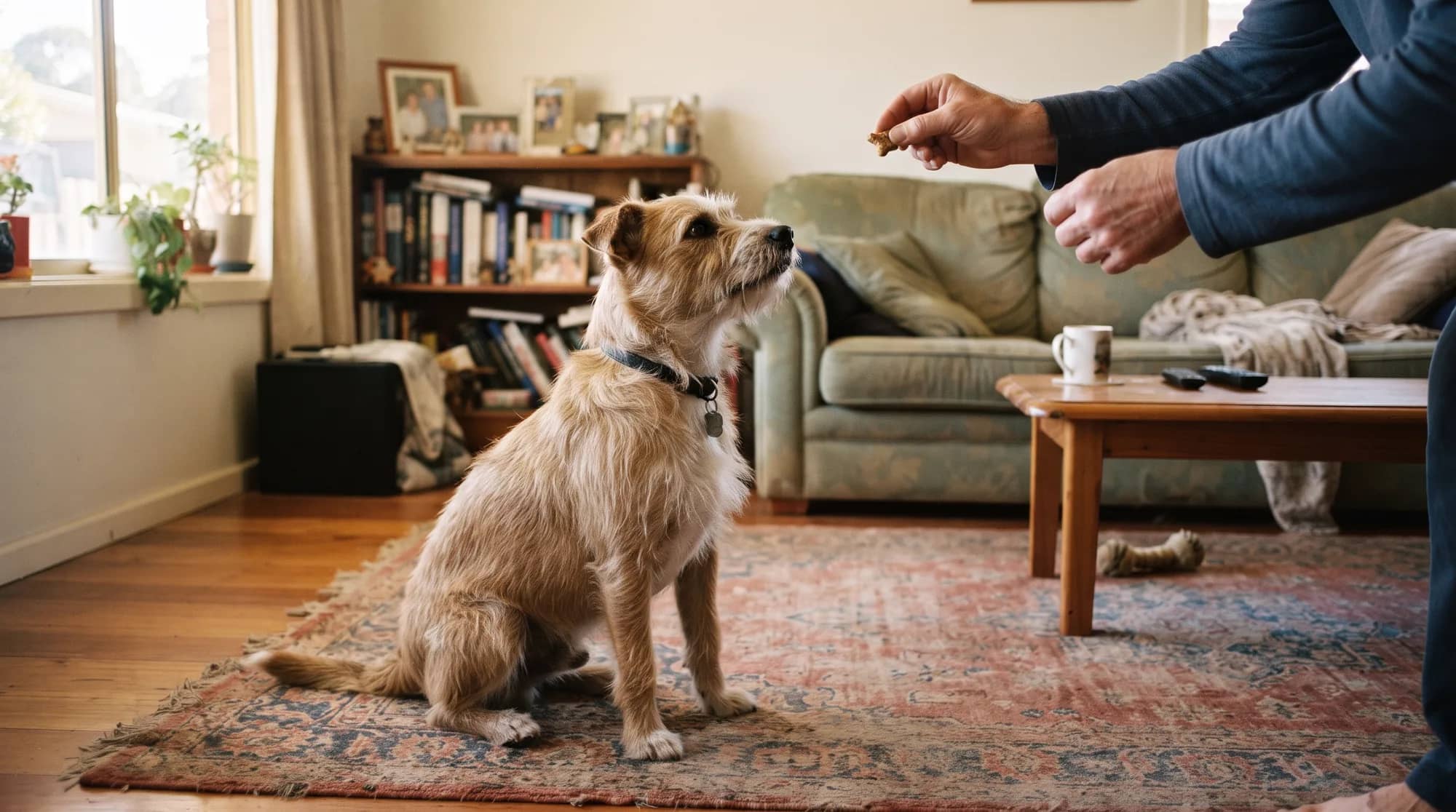
So when your dog is in the position you want — beside you, lead slack — mark it and pay it. A word ("yes", "good", whatever you like, used consistently) and a small piece of food, delivered at your leg, not out in front. Where you deliver the food is where your dog will start hanging around, so deliver it exactly where you want your dog to be.
Do this a lot at first. Every few steps. You are not bribing, you are showing your dog that the loose-lead position is where good things happen, and it is much faster than waiting for them to guess.
Then thin it out. Every few steps becomes every ten, becomes every fifty, becomes occasionally. Within a few weeks the food is nearly gone and the position holds because it has become the default.
Step four: let sniffing be the reward
A lot of pulling is a dog trying to get to a smell. So use that.
Pick a phrase — "go sniff" works — and use it deliberately. Walk nicely for a stretch, then release your dog to a patch of grass with the phrase. Now sniffing is something you give, on a loose lead, rather than something your dog has to drag you towards.
This one change does more for most dogs than everything else combined, because for the average dog a good sniff is worth more than any treat you are carrying.
What this looks like on a southern Adelaide footpath
A few local realities worth planning around.
Estate streets — Seaford, Seaford Meadows, the newer Aldinga and Happy Valley estates — have tight corners and short blocks. Great for the stop-start method actually, because there is always another corner to work towards. Less great if there is a dog behind every second fence, because a dog that is aroused cannot learn. Find the quietest circuit you have.
The esplanades at Brighton and Glenelg, and the Coast Park path, are the hardest environments in the whole area for this. Narrow, linear, packed with bikes and other dogs. Do not start there. Get the skill solid on a quiet street and take it to the esplanade when it is genuinely reliable.
Hills-side streets in Hallett Cove, Blackwood and Flagstaff Hill add gravity to the problem. Going downhill your dog has physics on its side and you have your heels dug in. Start uphill or on the flat.
When pulling is actually something else
Worth ruling out before you spend a fortnight on technique.
If your dog pulls specifically towards or away from other dogs, and there is barking or lunging involved, that is not a lead-manners problem — that is reactivity, and the plan is different. The stop-start method will not touch it, because a dog over its arousal threshold cannot learn anything.
If your dog is fine on lead everywhere except one particular route, something on that route is the issue.
And if your dog has recently started pulling when it never used to, particularly if it is older, get the vet to check it over. Pain changes gait and behaviour in ways that look a lot like disobedience.
How long it takes
For an average dog, with an owner who is consistent, a noticeable improvement in about a week and something genuinely reliable in three to six. Longer for a dog that has been pulling for six years, because there is more history to overwrite.
The bit that determines it is not technique — it is whether the whole household does the same thing. If you do the stop-start method every morning and your partner lets the dog tow them around the block every evening, your dog will simply learn that the rules depend on who is holding the lead. Dogs are excellent at that kind of discrimination. It is the single most common reason this fails.