The single most valuable training window in your dog's entire life runs from about three weeks to about sixteen weeks of age.
By the time most people book a trainer, it has closed.
That is not a criticism — nobody tells you. You collect a puppy at eight weeks, you are told to keep it inside until the vaccinations are done, and you spend the next six weeks in the house with a small animal that bites. By the time it is safe to go out and you feel ready to start, the most important part is over.
So here is what that window is, what to do with it, and what to do if you have already missed it.
What actually happens between 3 and 16 weeks
During this period a puppy's brain is building its baseline model of the world. Specifically, it is deciding what is normal and safe.
Anything a puppy meets in this window, in a calm and positive way, tends to be filed permanently under "fine". Anything it does not meet is more likely to be filed under "unknown", and unknown things become suspicious later. That is the mechanism behind an enormous proportion of adult fear and reactivity: not something bad that happened, but something that never happened at all.
After about sixteen weeks, the door does not slam shut — dogs can and do learn new things forever — but it gets significantly harder. What takes ten minutes at ten weeks takes months at ten months.
This is why the answer to "when should I start training my puppy" is: the day it comes home. There is nothing to wait for.
What socialisation actually means
This is the part that gets badly misunderstood, and getting it wrong does more damage than doing nothing.
Socialisation is not meeting as many dogs as possible. It is not a puppy free-for-all at the dog park. It is not being passed around a barbecue for two hours.
Socialisation is your puppy calmly observing a wide variety of things and learning that none of them are a problem.
The distinction matters enormously. A puppy that is comfortable, watching from a distance, and choosing to approach in its own time, is learning that the world is safe. A puppy that is overwhelmed, cornered, or pinned by an over-enthusiastic adult dog is learning the opposite — and one genuinely bad encounter at ten weeks can produce a reactive dog at ten months.
The rule of thumb: if your puppy's body is loose, its tail is up, and it is choosing to look at the thing, you are in the right place. If it is trying to get away, tucked, freezing, or hiding behind your legs, you are too close. Increase the distance. Do not push through it.
A list worth working through
The goal is variety, not volume. Aim for a handful of new things each week, all at a comfortable distance.
Surfaces: grass, sand, concrete, gravel, tiles, timber decking, metal grates, wobbly things.
Sounds: traffic, vacuum, hair dryer, doorbell, thunder recordings, kids playing, bin trucks, power tools.
Sights: bikes, scooters, skateboards, prams, wheelchairs, hi-vis vests, hats, umbrellas, people with beards, people carrying things, people running.
Places: a car park watched from the boot, a quiet cafe, outside a school at pick-up, a hardware store car park, a beach out of season, a bush trail.
Animals: calm, healthy adult dogs you actually know. Cats if relevant. Livestock at a distance if you are on acreage. Birds.
Handling: paws touched, ears looked in, mouth opened, collar grabbed, brushed, picked up, held still. Do this daily and your vet will love you forever.
The vaccination question
This trips everyone up, so let me be clear about the trade-off.
Your puppy is not fully protected until its vaccination course is complete, and parvovirus is a genuinely serious disease. That is real.
But the behavioural cost of missing the socialisation window is also real and well documented. Behaviour problems are a leading reason dogs are surrendered and euthanised — considerably more common than the diseases people are avoiding.
The resolution most vets and behaviour professionals now recommend is: socialise carefully rather than not at all.
That means carry your puppy in busy or unknown areas rather than putting it on the ground. Use your own yard, friends' yards, and clean surfaces. Let it watch the world from your arms or from the car boot. Restrict dog contact to dogs you personally know are healthy and vaccinated. Avoid dog parks, and avoid areas where lots of unknown dogs toilet.
Talk to your own vet about local risk — they know what is circulating in your area. But do not spend eight weeks indoors.
The three things that actually make people cry
Socialisation is the strategic part. These three are what make the first month feel unsurvivable.
Biting
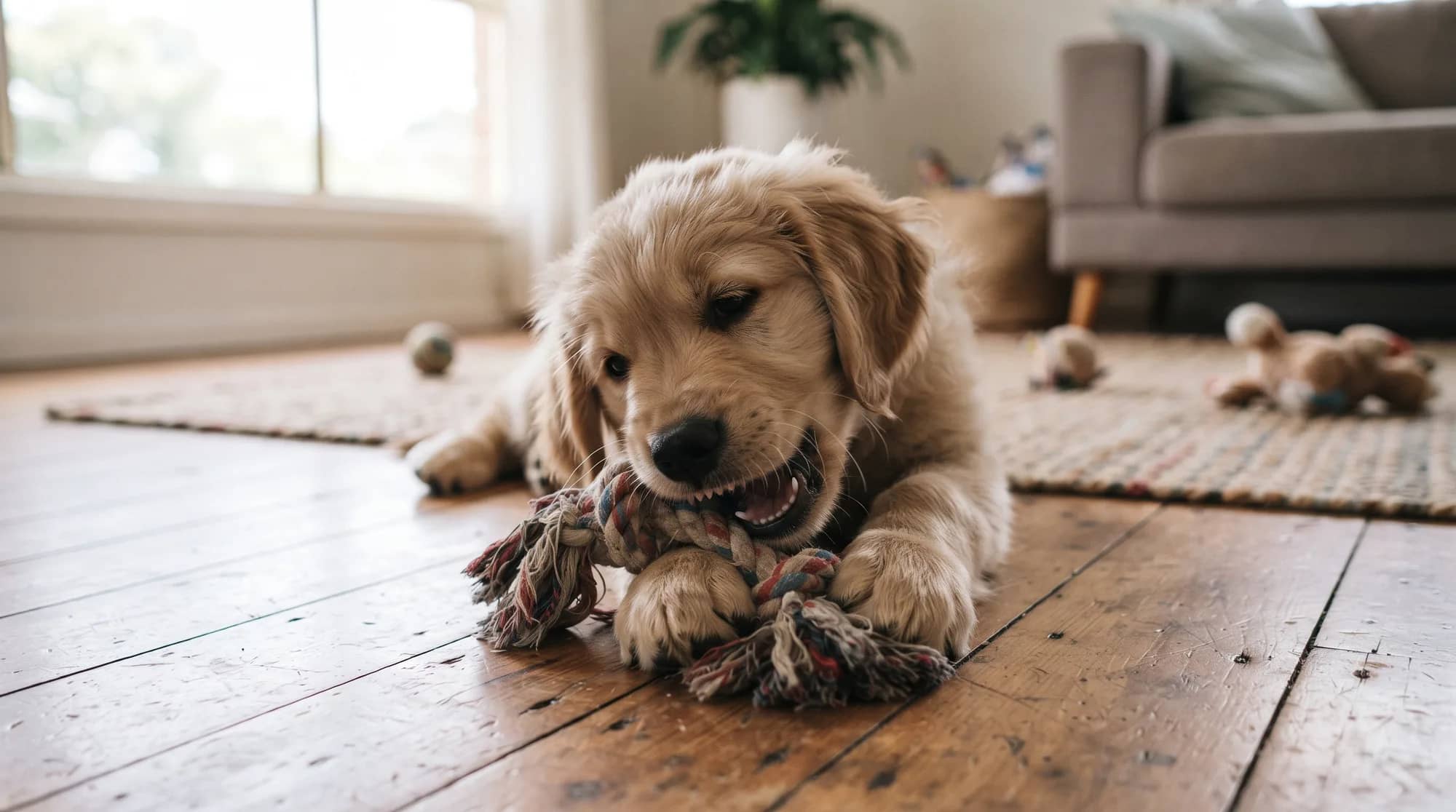
Puppies bite. It is normal and developmentally necessary — it is how they learn to control the force of their jaws, which is a skill you very much want them to have as an adult.
What you are aiming for is not "stop biting" but "bite softer, and stop when asked". Redirect onto something appropriate constantly. When teeth hit skin, the game ends — you stand up, disengage, and go boring for twenty seconds. Most importantly: a tired puppy bites much harder than a rested one, so if biting has escalated, the answer is usually more sleep, not more correction.
Toileting
It is a supervision and routine problem, not an intelligence problem. Out after waking, after eating, after play, and every hour or so in between. Go with them, wait, and pay properly when it happens outside. Accidents indoors mean you missed a supervision window — clean it with an enzymatic cleaner and move on. Never punish it; all that teaches is to toilet where you cannot see.
Settling
The one owners underestimate and then rate highest afterwards.
Puppies need an enormous amount of sleep — somewhere in the region of eighteen to twenty hours a day — and most household puppies get nowhere near it, because every time they wake up someone plays with them. An over-tired puppy looks exactly like a hyperactive one: biting, zooming, unable to switch off, incapable of learning anything.
Teach a settle deliberately. A pen or crate, a routine, and enforced downtime. It is also the single best predictor of whether that dog will develop separation problems later, which is why it gets attention early rather than being left to sort itself out.
Doing this around here
The southern suburbs are actually well set up for this if you are deliberate about it.
Noarlunga is the standout — river trails for calm outdoor exposure, the estuary, beaches at Port Noarlunga and Christies, and Colonnades for genuine busy-retail sights and sounds. Four completely different environments within ten minutes. Watch the car park from thirty metres, not from the middle of it.
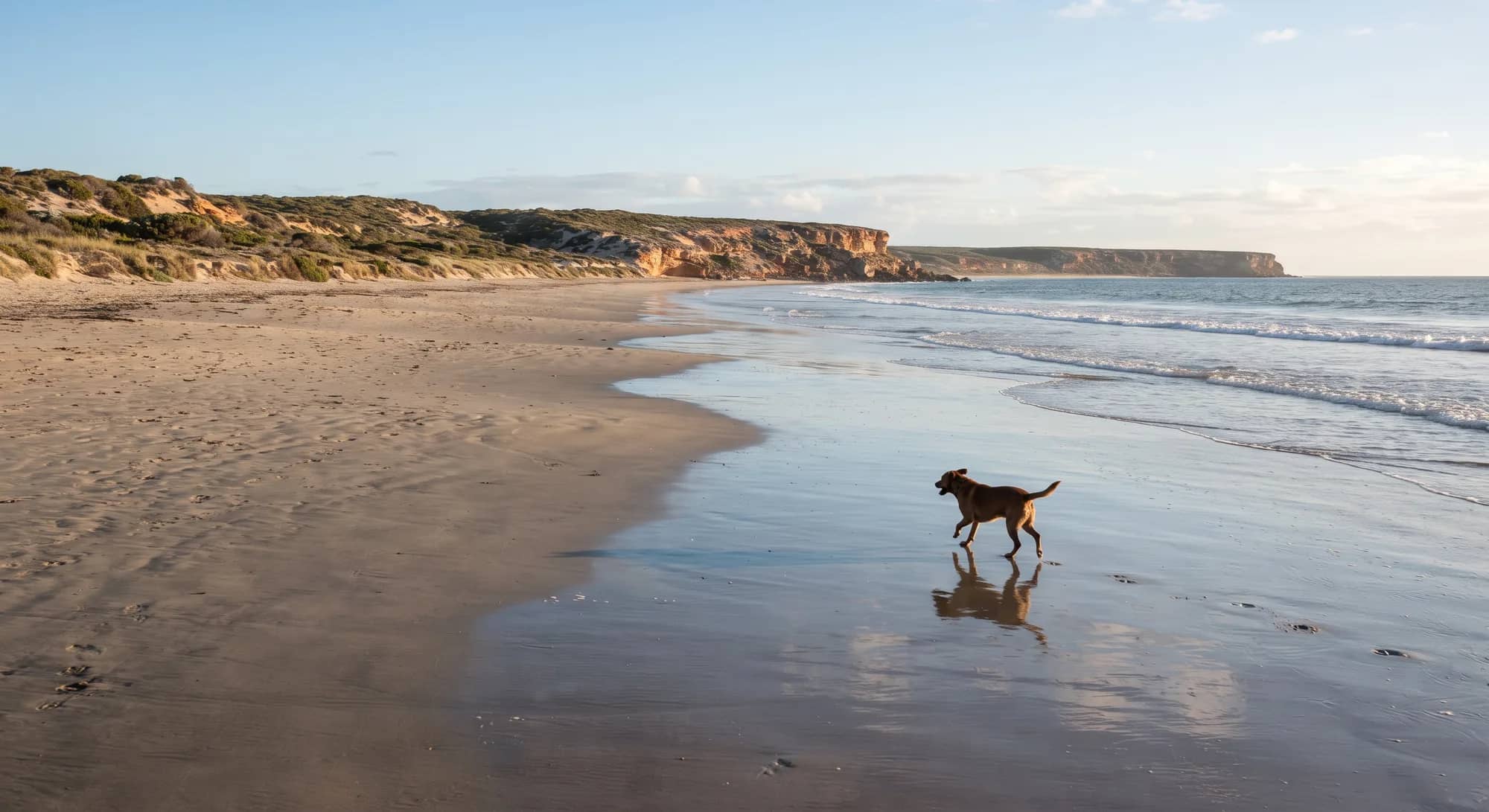
Beach suburbs — Brighton, Glenelg, Aldinga, Moana — give you sand, surf noise and open space. Off-season and early morning are ideal; a puppy's first beach should not be a January Sunday.
Victor Harbor and the Fleurieu have a specific trap: a puppy raised over winter has genuinely not met the town it lives in. The causeway, the horse tram, Granite Island and the foreshore are a completely different environment in January, and a nine-month-old adolescent meeting all of it at once is the worst possible timing. If your puppy is a winter puppy, deliberately manufacture crowd and noise exposure, and plan a graduated re-introduction in spring.
The inner south and Unley are easy for urban exposure and hard for space. Footpath encounters happen at close range, so use the ovals and reserves for anything involving other dogs.
If you have already missed the window
You have not ruined your dog.
A dog past sixteen weeks can absolutely learn that new things are fine. It takes longer, it needs to be more gradual, and you have to be more careful about not pushing past what your dog can cope with. But the process is the same — distance, calm observation, positive association, patience.
What you should not do is decide it is too late and stop trying. And what you really should not do is assume that a nervous adolescent will "grow out of it". Left alone, fear tends to generalise, not resolve.
The best time to start was eight weeks. The second best time is today.