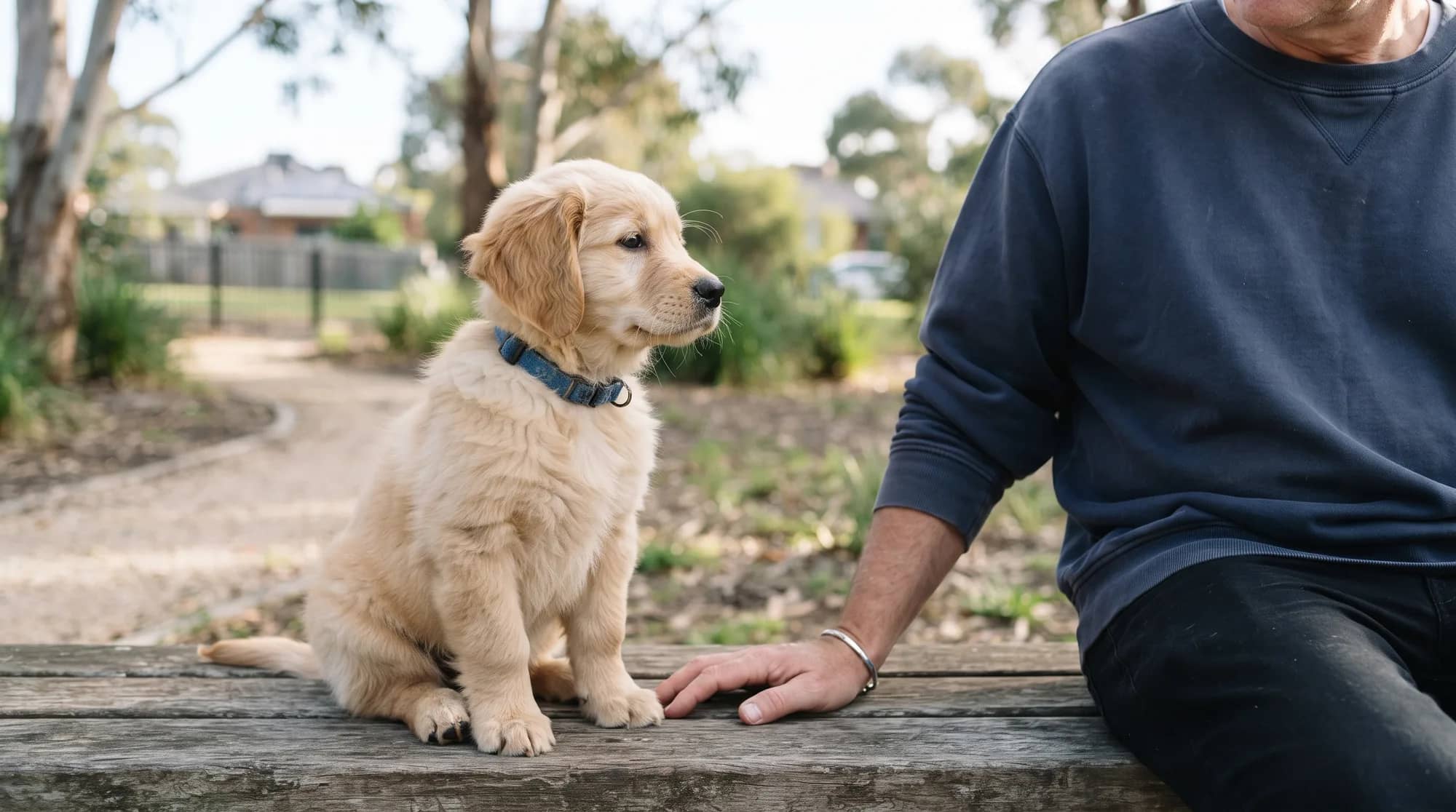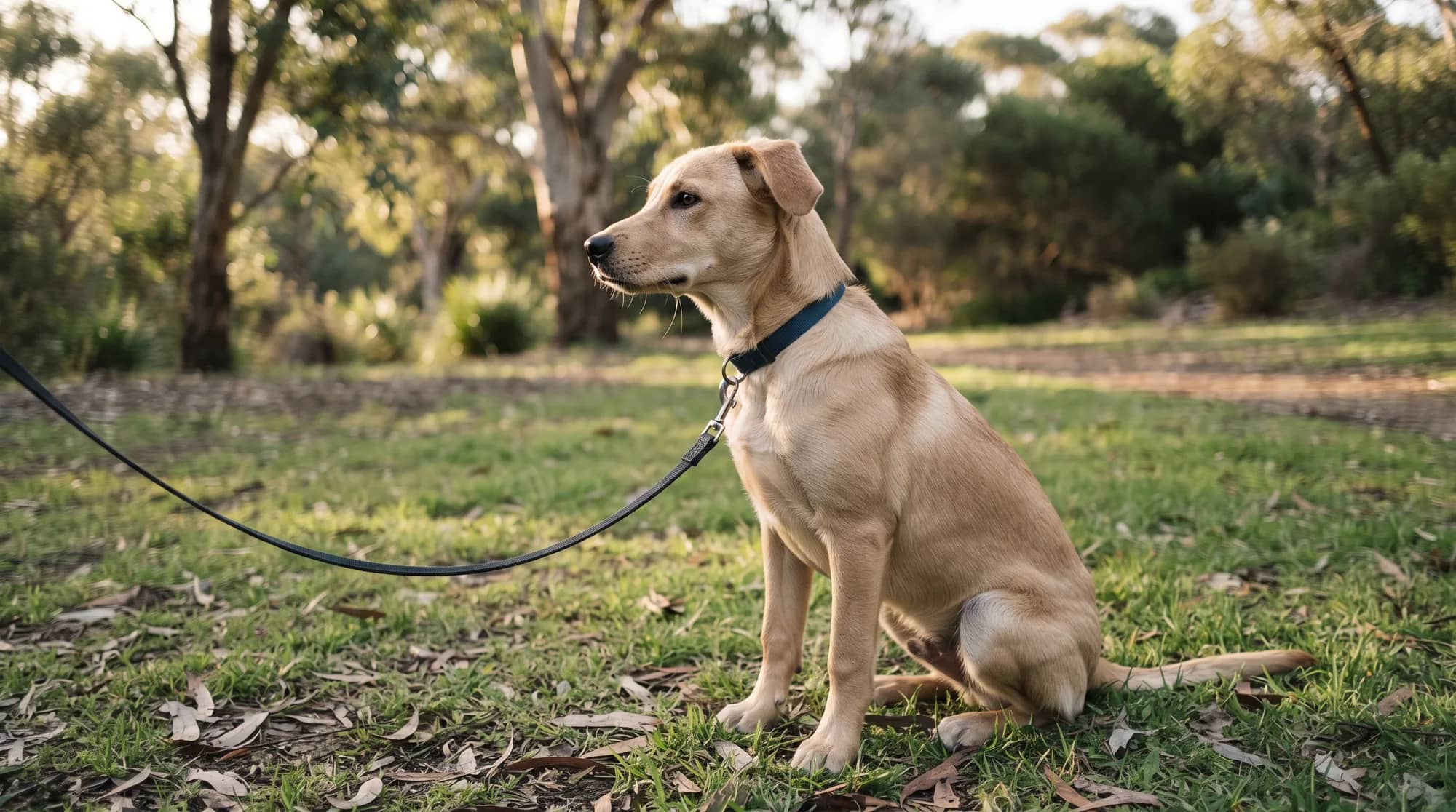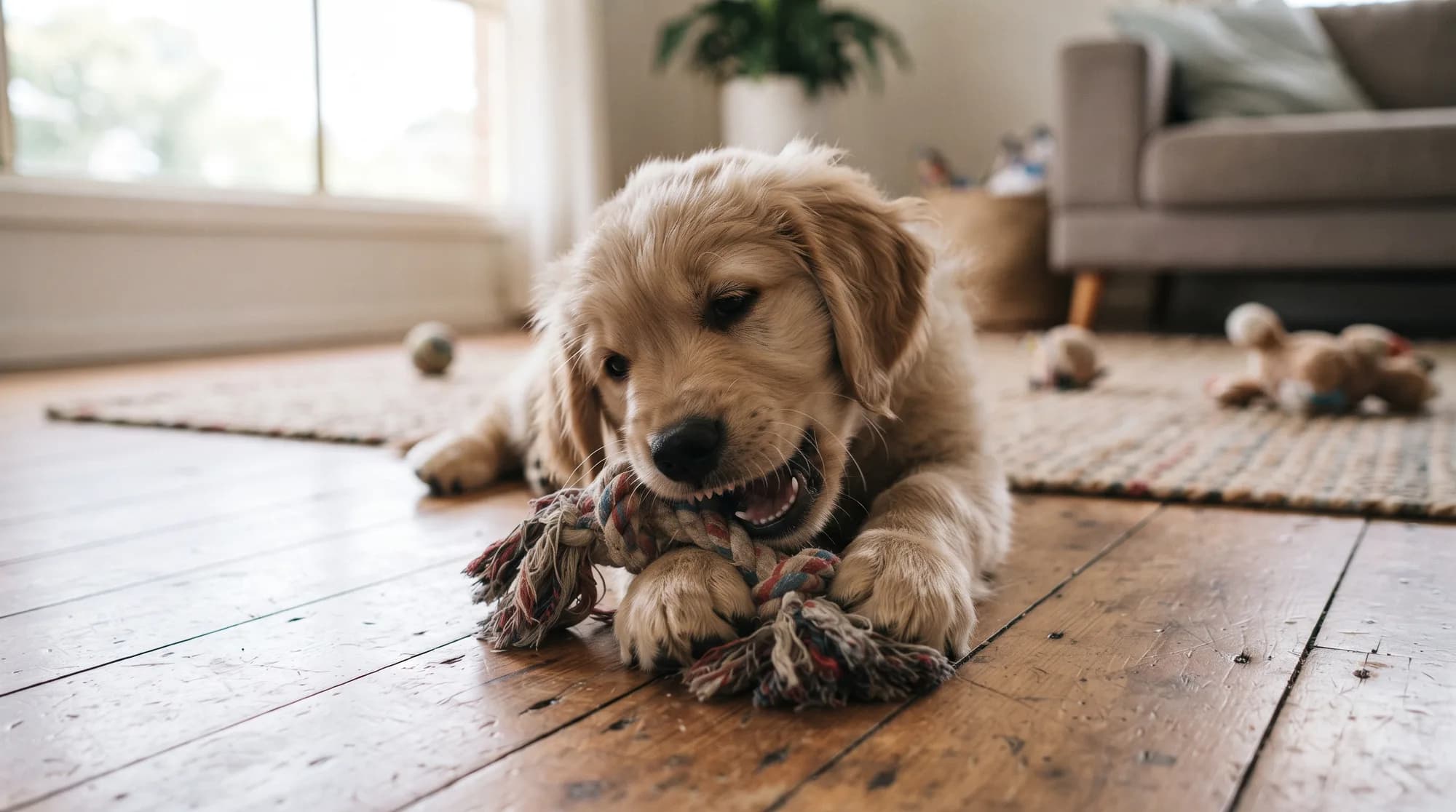
Your forearms look like you lost an argument with a blender. The kids are frightened of the puppy. Somebody has said the word "aggressive" out loud.
It isn't. Puppy biting is completely normal, developmentally necessary, and temporary. But there is a right way and a wrong way to handle it, and the wrong ways are unfortunately the ones most commonly suggested.
Why puppies bite
Three reasons, and they overlap.
Exploration. Puppies have no hands. Everything they investigate, they investigate with their mouth. That includes you.
Teething. From roughly three to six months, adult teeth are pushing through and the gums are sore. Chewing genuinely relieves it.
Learning bite inhibition. This is the important one. A puppy is learning how hard it can bite before something bad happens — and it can only learn that by biting things and getting feedback.
This last point is worth sitting with, because it changes the goal. You are not trying to eliminate biting. You are trying to teach your puppy to control the force of its jaws, so that as an adult, in a startled or painful moment, it has a reflex that pulls the pressure back.
A dog that never learned bite inhibition as a puppy is not a safer dog. It is a dog with no volume dial.
Why yelping often makes it worse
The classic advice is to yelp like a hurt littermate when the puppy bites too hard.
It works for some puppies. For a great many others — particularly the excitable ones, and particularly terriers and working breeds — a high-pitched squeal is the most exciting thing that has happened all day. You have just made the game better. The biting escalates.
If you have tried yelping and your puppy got worse, that is why. Stop doing it.
What actually works
Redirect, constantly
Have appropriate chew items within reach in every room. When teeth arrive on skin, put something better in the mouth. Not as a reward for biting — as a substitution, immediately, before the biting has become a game.
Frozen items are particularly good during teething. A wet, frozen tea towel twisted into a rope costs nothing and is genuinely soothing.
End the game, quietly
The rule your puppy needs to learn: teeth on skin means the fun stops.
So when it happens, without drama and without a sound, stand up and disengage. Fold your arms, turn away, become boring for fifteen or twenty seconds. Then re-engage calmly.
No shouting, no squealing, no pushing the puppy away — pushing is interactive and puppies read it as play.
If the puppy follows and keeps biting, step over a gate or into another room for thirty seconds. Not a punishment, just a full stop. Then come back.
The consistency is everything here. If it works four times out of five, your puppy learns that persistence occasionally pays, which is worse than not trying.
Manage the arousal, don't just react to it
The biggest lever is not what you do when the biting happens. It is preventing the state that produces it.
Sleep. A puppy needs something like eighteen to twenty hours a day, and almost no household puppy gets it, because every time it wakes someone plays with it. An over-tired puppy is a biting machine. If your puppy's biting is at its worst in the evening, or in a predictable late-afternoon burst, it is over-tired — and the fix is enforced downtime in a pen or crate, not more exercise.
This is the single most common thing I fix in puppy consultations. Owners are astonished at how much of the biting disappears when the puppy is properly rested.
Chewing outlets. A puppy with nothing appropriate to chew will chew you.
Calm greetings. If everyone in the house arrives home and immediately winds the puppy up, you are training arousal on a schedule.
Teach a mouth-off cue
Pick a word — "off", "leave", "enough" — and use it consistently, once, just before you disengage. Over time it becomes a signal your puppy can respond to before the disengagement is needed.
The kids
This is the part that makes households miserable, so it deserves its own section.
Kids and puppies wind each other up. Kids run, squeal, flap their hands and move unpredictably — all of which look exactly like prey and play to a puppy, which then chases and bites, which produces more squealing. It is a feedback loop and it will not resolve on its own.
Practical rules that actually work:
- The puppy gets a safe space and the kids do not go into it. A pen or crate that is genuinely off-limits.
- Kids sit down to interact with the puppy. Sitting removes the running and lowers the arousal instantly.
- Kids get a job. Holding a chew toy for the puppy to grab instead of hands. Being the one who says "off" and stands up. Being in charge of dropping treats for calm behaviour. Involved kids are part of the solution; bystander kids are part of the problem.
- Separate before it goes wrong, not after. The most reliable time to intervene is five minutes before anyone is upset.
What not to do
Do not hold the muzzle shut. It teaches your puppy that hands near its face are unpleasant, which is a genuinely bad lesson to install in an animal you will need to handle for the next fifteen years.
Do not scruff, pin, or "alpha roll". Dominance framing has been out of date for decades. What it actually produces is a puppy that is frightened of you, and frightened dogs bite harder, not less.
Do not put your fingers down its throat, hold its tongue, or use bitter spray on your own hands. All of these do the same damage: they make you the unpleasant thing.
Do not punish growling. If your puppy growls during play or when you approach its food, that is communication, and it is useful. Punish it and you do not remove the feeling — you remove the warning.
When to actually worry
Almost all puppy biting is normal. A few things are worth a closer look:
- Biting that is silent, stiff and still rather than wriggly and vocal
- Biting that happens specifically around food, a bone, or a particular spot — that is guarding, and it needs handling differently
- Biting that is worse with one specific person in a way that does not look like play
- A puppy that seems unable to come down from arousal at all, ever, even with proper rest
- Biting that is getting harder over time rather than softer
None of these are emergencies, but they benefit from someone looking at them properly rather than being waited out.
When it ends
Teething usually finishes around six months and the biting drops off substantially with it. Most households notice a real improvement between four and five months, provided the handling has been consistent.
If your puppy is still biting hard at seven or eight months, something in the pattern is maintaining it — usually inconsistency between household members, or chronic over-tiredness, or a household where the biting has accidentally become the most reliable way to get attention.
That is fixable too. It just needs someone to work out which one it is.