
Blog category
Puppy Training
The first few months: biting, socialisation, toileting and settling. Get these right and the rest gets easier.
Where to start
Which guide do you need?
The most valuable training window in a dog's life runs from roughly three to sixteen weeks, and most people start using it at six months. That is not anyone's fault — nobody tells you. You bring a puppy home, you are told to keep it inside until the vaccinations are done, and by the time you feel ready to start, the easiest part is already behind you.
These guides are about that window and the three things that make new owners genuinely miserable inside it: biting, toileting and a puppy that will not settle. All three are normal, all three are temporary, and all three respond much faster to a change in routine than to a change in technique.
Start with the socialisation guide if your puppy is under sixteen weeks — it covers what socialisation actually means, which is not "meet as many dogs as possible", and includes the vaccination trade-off in plain terms. Start with the biting guide if your forearms have taken a beating, and pay particular attention to the section on sleep. An over-tired puppy bites far harder than a rested one, and more sleep fixes more puppy biting than any correction ever has.
Toileting and settling do not have guides of their own yet, so here is the short version of both. Toileting is a supervision and routine problem rather than an intelligence one: out the door after every sleep, every meal and every burst of play, praise the instant it happens outside rather than thirty seconds later back indoors, and clean the accidents with an enzymatic cleaner so the spot stops advertising itself. Most puppies who are "nearly there and then suddenly not" have simply been given more unsupervised freedom than they had earned.
Settling is usually a sleep problem in disguise. A puppy of eight to twelve weeks needs somewhere in the order of sixteen to twenty hours of sleep a day, and almost none of them get it in a house with kids, a telly and people who want a cuddle with the new puppy. If yours is at its worst between four and seven in the evening — biting hardest, listening least, tearing around like something possessed — it is not winding up for a big night. It is overtired. A quiet pen or crate in the late afternoon, before the meltdown rather than after it, does more for that hour than any correction will.
2 articles
All Puppy Training guides
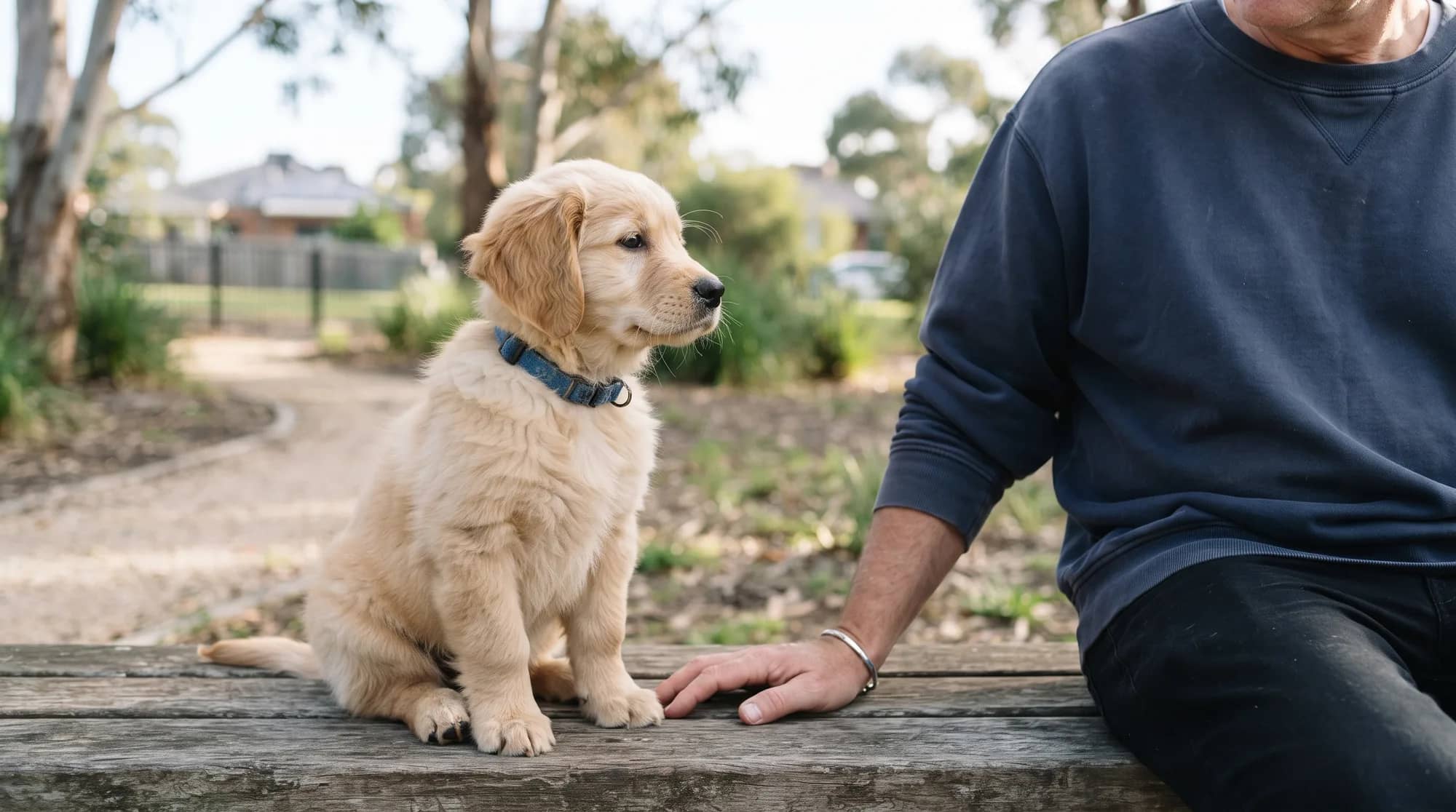
Puppy Training
When Should Puppy Training Actually Start?
The most valuable training window in your dog's entire life closes at around sixteen weeks. Most people start using it at six months.

Puppy Training
Puppy Biting: Why It Happens and How to Stop It
Your hands look like you lost a fight with a blender. This is normal, it is developmentally necessary, and it does end — faster if you handle it well.
Other topics
Browse the rest
Need a hand?
How I help with puppy training
Reading gets you a long way. This is the part where someone looks at your actual dog.
Local help
Where I do this work
This all applies wherever you are, but the local detail changes — the councils, the parks, the beaches and their seasonal hours. These pages have it.
- Aldinga BeachCity of Onkaparinga
- BrightonCity of Holdfast Bay
- Happy ValleyCity of Onkaparinga
- McLaren ValeCity of Onkaparinga
Or the wider area:The Southern ValesThe Southern BeachesAdelaide's Southern Suburbs
Ready when you are
Let's sort your dog out.
Tell me what's going on and I'll tell you straight whether I can help — and roughly what it will take. No obligation, no pressure. Southern suburbs of Adelaide — CBD to Victor Harbor.
Send a quick enquiry
Four things and I’ll come back to you. If it is urgent, ring instead — that is always faster.