
About
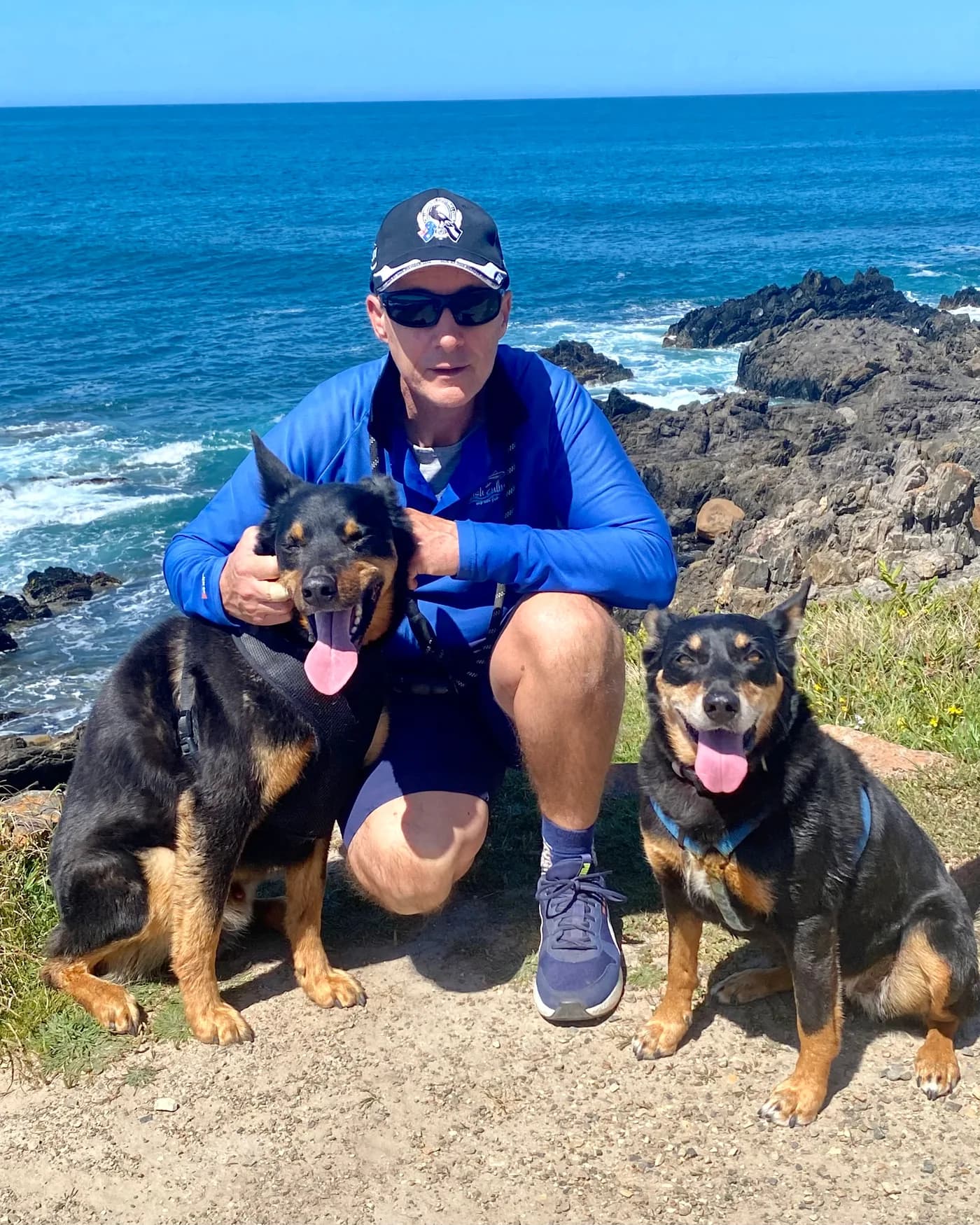
G'day — I'm Faz.
I'm the bloke behind Dog Obedience Guy. I help owners across southern Adelaide build better behaviour, a stronger bond and a calmer, happier dog — in their own home, at their own pace.
How I got here
Five years, a few thousand dogs, and one thing I kept noticing.
I have been interested in dog training for a long time — documentaries, books, and more hours than I would care to admit watching my own dogs and working out why they do what they do.
For the last five years I have worked with dogs hands-on, running a mobile dog wash and grooming service. That is a lot of dogs, in their own homes, plenty of them nervous and some of them difficult — every one of them meeting a stranger who is about to do something they are not sure about. You learn to read a dog quickly doing that job, and you learn to get them on side before you do anything else.
What I found is that I am genuinely good at it. Plenty of people say they love dogs. I can tell you something more useful than that: dogs love me. They settle for me, they trust me quickly, and that is most of the work done before any training starts.
Along the way, grooming customers started asking me about behaviour — the barking, the pulling, the dog that would not settle. I helped where I could, and the change was often immediate enough that people were genuinely amazed. That happened enough times that it seemed daft not to offer it properly.
So I completed a Certificate in Dog Psychology, Behaviour & Training, added a Certificate in Caring for Dogs, and started Dog Obedience Guy.
The best part of the job is watching someone understand their own dog properly for the first time, and then give it the calm, clear leadership every dog is looking for. Most dogs are not being difficult. They are waiting for somebody to be clear with them.
Qualifications
- Certificate in Dog Psychology, Behaviour & Training
- Certificate in Caring for Dogs
Plus five years working hands-on with dogs as a mobile groomer — which is where most of what I know actually came from.
The approach
Most dogs aren’t being difficult. They’re being consistent.
Consistent with the training they have actually received — which for most dogs is an accidental mix of rewarded behaviours, rules that change depending on who is home, and a few commands taught in the one room where nothing interesting ever happens.
When people tell me their dog “knows what it did wrong” or is “being stubborn”, what is usually going on is much simpler and much more fixable. The dog has never been given clear, consistent information about what works. Give it that, and the change can be genuinely startling.
The slow part is not the dog. It is the consistency afterwards, and that is the part I actually coach you on. Anyone can get a dog to do something impressive while they’re standing in your lounge room. The job is leaving you able to do it after I’ve gone.
I work across the southern suburbs of Adelaide — from the CBD and the inner south, through the beaches and the Onkaparinga suburbs, out to McLaren Vale and Aldinga, and down the Fleurieu to Victor Harbor. In your home, one-on-one, evenings and weekends included.
“Making your dog a superhero.”
Not a slogan I picked at random. Most dogs are capable of far more than their owners think — they have just never been shown clearly what is being asked.
How I work
Five things I hold to
Not a philosophy statement for the sake of one — these are the actual decisions that shape every session.
Positive, and actually effective
Those two things are not in tension. Training that relies on frightening a dog produces suppression, not change — and it reliably makes fear and anxiety problems worse. Positive methods, applied properly and consistently, produce a dog that wants to work with you.
In your house, not a hall
Dogs are much worse at generalising than people assume. A skill learned in a training hall does not automatically transfer to your front door. So I skip the transfer problem entirely and work where the behaviour actually lives.
I'll tell you the truth
Including when it is not what you want to hear. If your dog needs a vet rather than a trainer, I will say so. If I think a case is beyond what I can help with, I will say that too. Nobody is well served by me taking a booking I cannot justify.
The whole household, together
One person doing everything right and three people doing something else is the most common reason training fails. Everyone gets involved, kids included, and the rules stop changing depending on who is in the room.
It should be fun
For you and for the dog. If training feels like a punishment for both of you, nobody keeps doing it, and consistency is the entire game. Making obedience achievable and fun is the whole point.
What I help with
Everything I'm called out for
Dog Obedience Training
Your dog already knows "sit". The question is whether they do it when a magpie lands on the fence.
Learn morePuppy Training
Everything your puppy learns in the next twelve weeks, they will believe for the rest of their life. Worth getting right.
Learn moreBehaviour Consultations
Some problems do not respond to more training. They respond to understanding what is actually driving them.
Learn moreReactive Dog Training
You have started walking at 6am so you do not meet anyone. That is not a walk, that is a covert operation.
Learn moreAggressive Dog Training
If you are frightened of what your dog might do, you need someone who will tell you the truth rather than sell you a quick fix.
Learn moreSeparation Anxiety
The neighbours have mentioned the howling. The door frame is destroyed. Your dog is not being naughty — it is genuinely panicking.
Learn moreBarking Dog Training
Barking is a symptom, not a diagnosis. Six different problems produce the same noise — and they need six different answers.
Learn moreIn-Home Dog Training
Your dog does not misbehave in a training hall. It misbehaves at your front door. So that is where we work.
Learn moreReal owners
What people say
After just 1 session with The Dog Obedience Guy I could already see improvement with Sammi. Today I walked both dogs, side by side with ease continuing the strategies I learnt. Thanks, one very happy customer
Have just finished our last session and I was given excellent help and ideas. Turns out it wasn't Ollie (it was me) 🤣 Thank you for all the help. Ollie loved it. Would definitely recommend. Thanks Faz
Where I work
Where I travel
Adelaide CBD, the inner south, the southern beaches, the City of Onkaparinga, McLaren Vale and the Fleurieu Peninsula through to Victor Harbor.
 27 suburbs
Adelaide's Inner South
Small blocks, shared fences and footpaths full of people. The inner south asks a lot of a dog.
Dog training in Inner South 26 suburbs
The Southern Beaches
Beach walks, esplanade crowds and off-lead hours that catch people out. Recall matters more here than anywhere.
Dog training in Southern Beaches 35 suburbs
Adelaide's Southern Suburbs
The heartland. Close-set housing, shared fences, and more council barking complaints than anywhere else I work.
Dog training in Southern Suburbs 22 suburbs
The Southern Vales
Vines, acreage and one of the best dog beaches in the state. Different geography, different problems.
Dog training in Southern Vales 25 suburbs
The Fleurieu & Victor Harbor
Hardest part of the state to find proper behaviour help. That is exactly why I come down here.
Dog training in FleurieuQuestions
Methods & approach
What is your training philosophy?
Do you use treats?
My dog is stubborn. Or dominant. Is that the problem?
Will you make my dog scared of me?
My dog has growled. Should I punish that?
Someone told me a tired dog is a good dog. Should I just walk him more?
Are some breeds harder than others?
Is it ever too late to train a dog?
Ready when you are
Let's have a chat about your dog.
Tell me what's going on and I'll tell you straight whether I can help — and roughly what it will take. No obligation, no pressure. Southern suburbs of Adelaide — CBD to Victor Harbor.
Send a quick enquiry
Four things and I’ll come back to you. If it is urgent, ring instead — that is always faster.