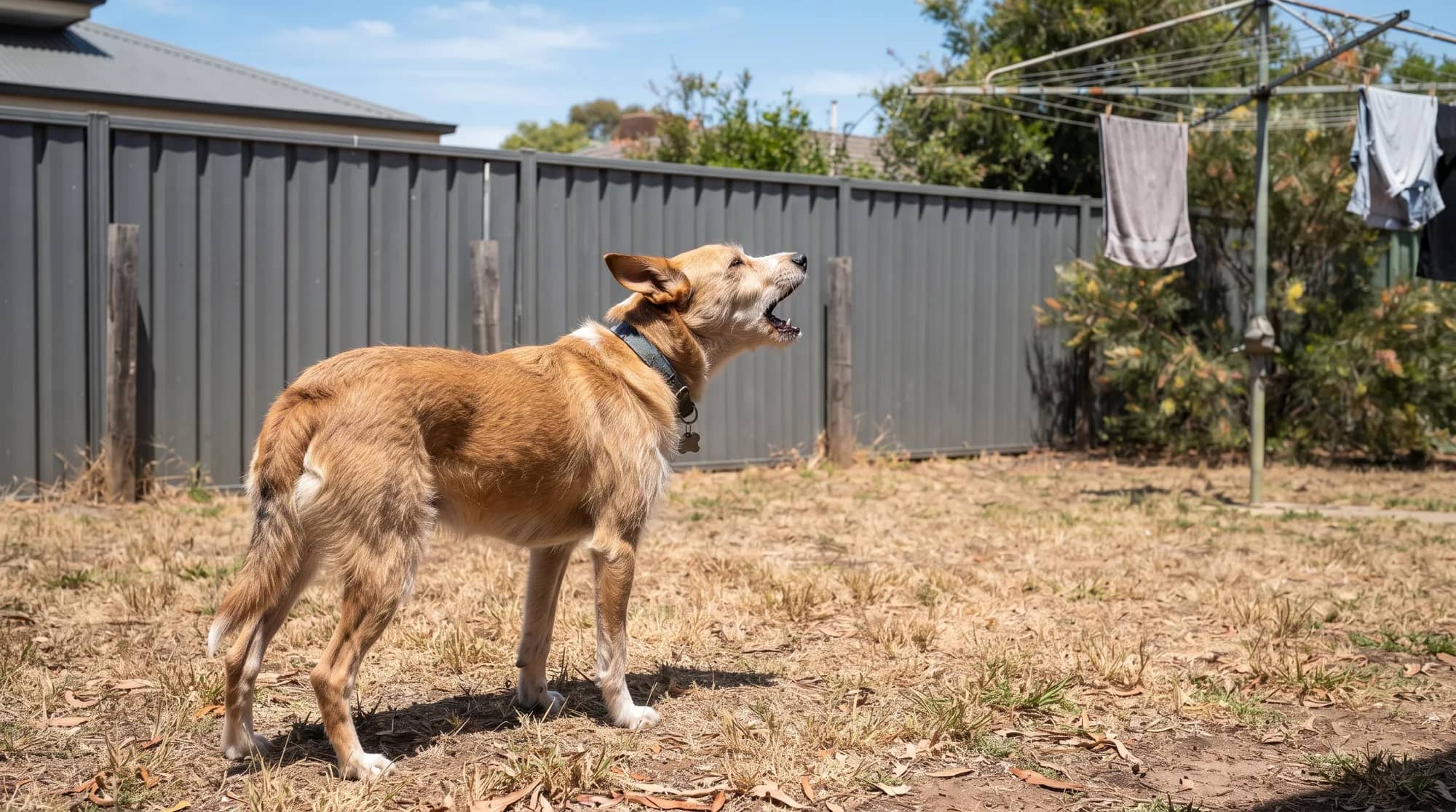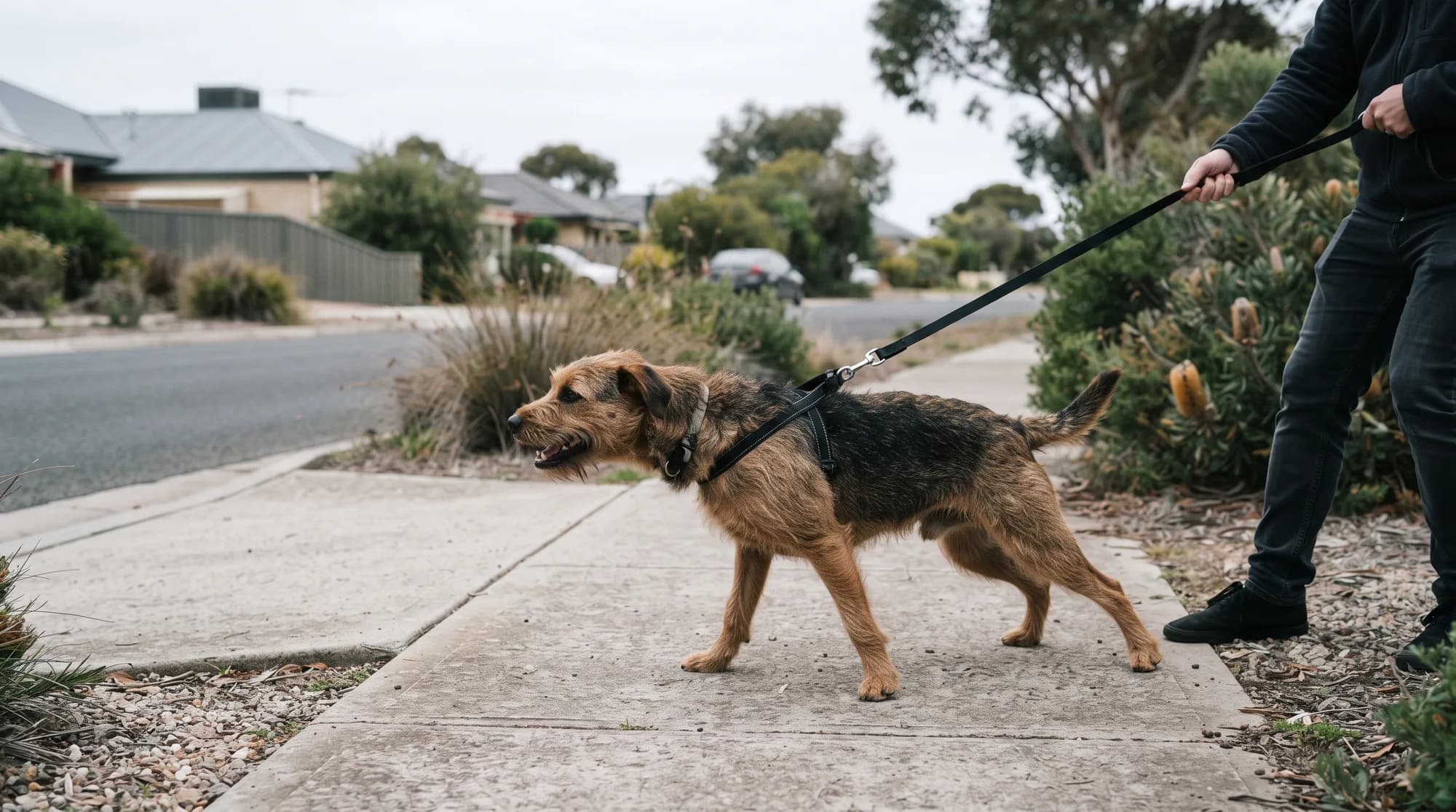
From the other end of the lead they look the same. Barking, lunging, teeth, a dog you can barely hold, and a walk that ends with you shaking.
But reactivity and aggression are not the same problem, and treating one as though it were the other is a large part of why so much training fails. Worse, it is why some dogs get significantly more dangerous while their owners are following advice that was never meant for them.
The short version
Reactivity is an over-the-top emotional response to a trigger. The dog is over-aroused — through fear, frustration or excitement — and the display is what comes out. In most reactive dogs, if the trigger came closer, the dog would not actually want contact. The barking and lunging is a strategy for making the thing go away, or a frustrated attempt to get to it.
Aggression involves intent to cause harm. The behaviour is aimed at making contact, and if the distance closed, the dog would follow through.
The catch is that these sit on a continuum, not in two boxes. A reactive dog that is repeatedly pushed past its threshold, punished for warning, or cornered can escalate into genuine aggression. That is the pathway most bite cases actually take, and it is entirely preventable.
Reading the difference
No single signal is diagnostic. You are looking at the whole picture.
What tends to indicate reactivity
- The display stops as soon as distance increases — the dog goes back to normal fairly quickly
- Lots of noise and movement: barking, spinning, bouncing, straining
- The dog is fine off lead with other dogs but terrible on lead (classic frustrated greeter)
- Body is loose and wriggly underneath the display — bouncing rather than braced
- It happens only in specific contexts — on lead, behind a fence, in the car
- The dog recovers within a minute or two once the trigger is gone
What tends to indicate aggression
- The display is quiet, still and stiff rather than loud and bouncy
- Forward, hard, committed body — weight over the front, braced
- Freezing before the reaction, often with a hard stare
- Behaviour that continues or escalates as the trigger comes closer
- The dog does not recover — it stays wound up, watchful, unable to settle afterwards
- There has been contact: a snap, a nip, a bite
- It happens around resources — food, a bone, a bed, a person
The one people misread most
The silent dog is the one to pay attention to. A dog that barks and lunges loudly is, in most cases, communicating. A dog that goes quiet, stiff and still, with a hard stare and a closed mouth, has often finished communicating.
Loud is usually less dangerous than silent. That runs against instinct, which is exactly why it is worth knowing.
Frustrated greeters — the most misdiagnosed dog in Adelaide
A huge proportion of what people call aggression is a frustrated greeter, and it is worth its own section because the treatment is completely different.
The picture: your dog is a delight off lead. It plays beautifully at the beach. But on lead, the moment another dog appears at twenty metres, it screams, lunges and thrashes on the end of the lead like something out of a horror film.
That dog is not trying to hurt anything. It desperately wants to go and say hello, the lead prevents it, and frustration comes out looking like rage. Off lead, it resolves the situation the normal way in three seconds.
Why it matters: if you treat that dog as aggressive and start correcting it — a check, a prong, a raised voice — you have now added something unpleasant to the presence of other dogs. Do that enough times and a dog that loved other dogs learns that other dogs predict discomfort. You have converted frustration into genuine fear-based reactivity, and from there into something worse.
It happens constantly, and it is entirely avoidable.
Fear-based reactivity
The other big category. The dog is not frustrated, it is worried, and the barking is a strategy: make the scary thing go away.
The critical thing about fear-based reactivity is that it works. The other dog does eventually go away — because the walk continues, or the owner crosses the road, or the other dog gets bored. From your dog's perspective, barking is a reliable and effective tool.
That is why it strengthens over time rather than fading. And it is also why the solution is not to stop the barking but to remove the need for it — by working at a distance where your dog does not feel threatened, and rebuilding from there.
Why the distinction changes everything
Distance work suits both — you cannot train a dog that is over its threshold, whatever the underlying emotion.
But the emotional target differs. A frustrated greeter needs to learn that not every dog is an opportunity, and that calm gets access. A fearful dog needs to learn that other dogs predict good things and never predict pressure. Applying the frustration plan to a fearful dog pushes it too close, too fast.
And aggression needs a safety layer that reactivity does not. Management first, muzzle conditioning where appropriate, a veterinary check for pain, and an honest risk assessment before any behaviour modification starts.
Get this wrong in the direction of "it's just reactivity" and someone can get bitten. Get it wrong in the direction of "he's aggressive" and you may spend a year suppressing a dog that just wanted to say hello.
Pain
Worth a paragraph on its own, because it is missed constantly.
A meaningful proportion of behaviour change that presents as aggression is a dog in pain. Sore hips, dental disease, ear infections, thyroid problems, undiagnosed injuries. Pain lowers tolerance for everything.
If your dog's behaviour has changed suddenly, if your dog is over about seven, or if the reaction is worse when touched in a particular place — see your vet before you see a trainer. Or see both. No amount of training fixes a sore dog.
Please do not punish the growl
If you take one thing from this article, take this.
A growl is a warning. It is your dog saying, clearly and non-violently, "I am not comfortable and I would like this to stop." It is the most useful thing your dog can give you.
Punish the growl and you do not change the underlying feeling. You just teach your dog that growling brings trouble. So it stops growling — and the next time it is pushed too far, it skips straight to the part that leaves a mark.
That is where "he bit with no warning" comes from. There was a warning. It got trained out.
Keep the growl. Thank the growl. Then work on the reason for it.
What to do next
If you are not sure which one you have, you do not have to guess, and you should not.
Record it. A phone video of a typical encounter tells a trainer more in fifteen seconds than a paragraph of description. Look at the body, not just the noise.
Then get someone to look at it properly. Both problems are workable. They are just workable in different directions, and the first thing worth spending money on is finding out which one you are actually dealing with.