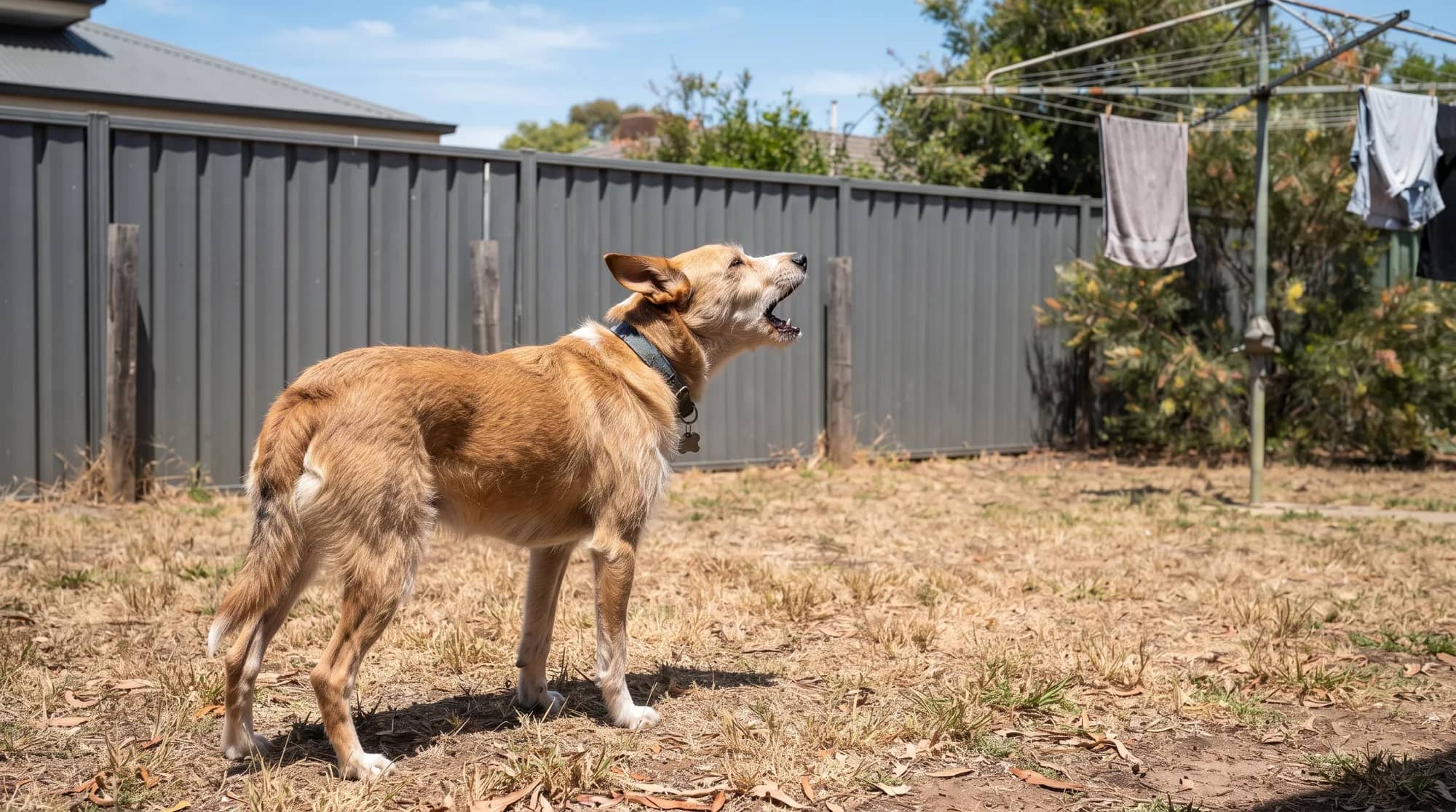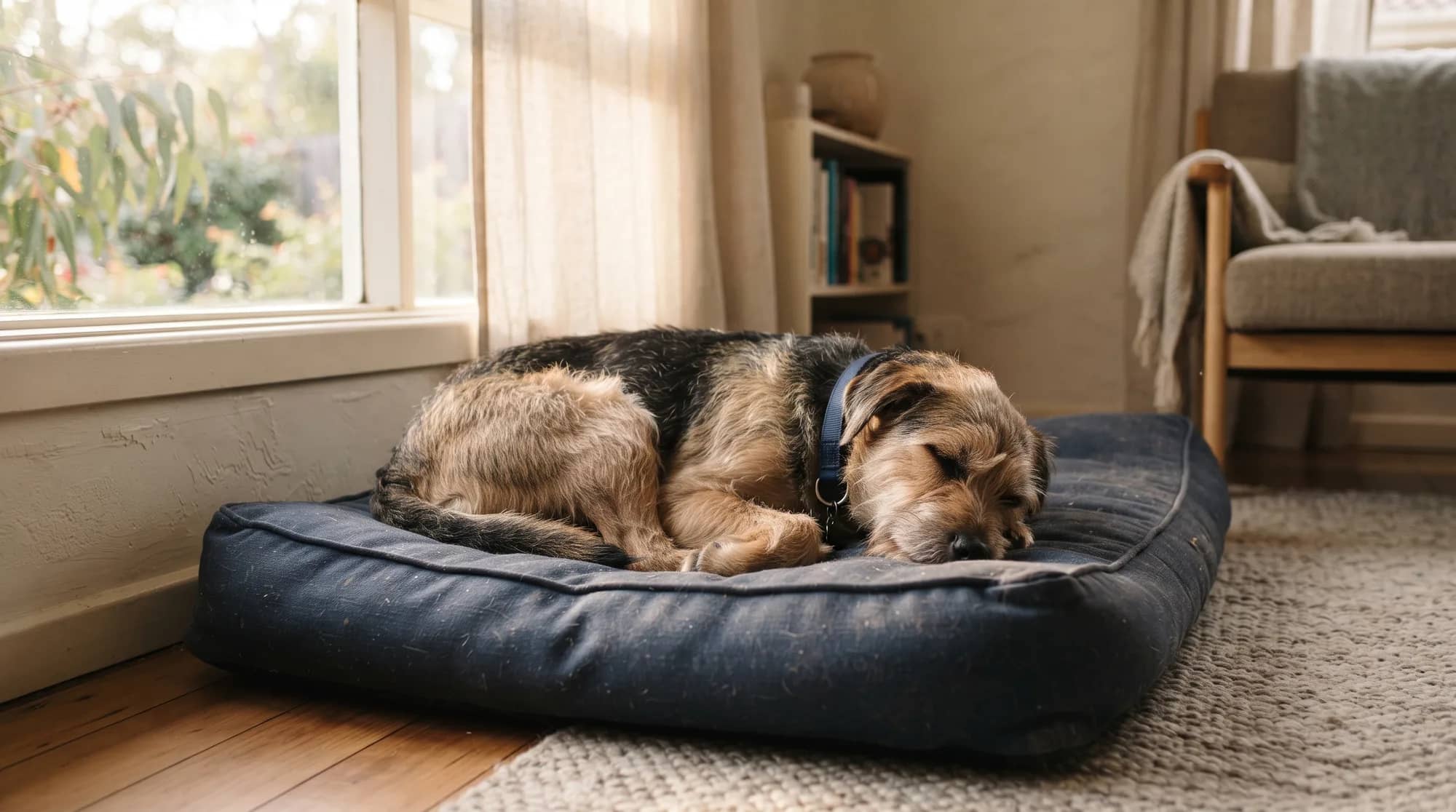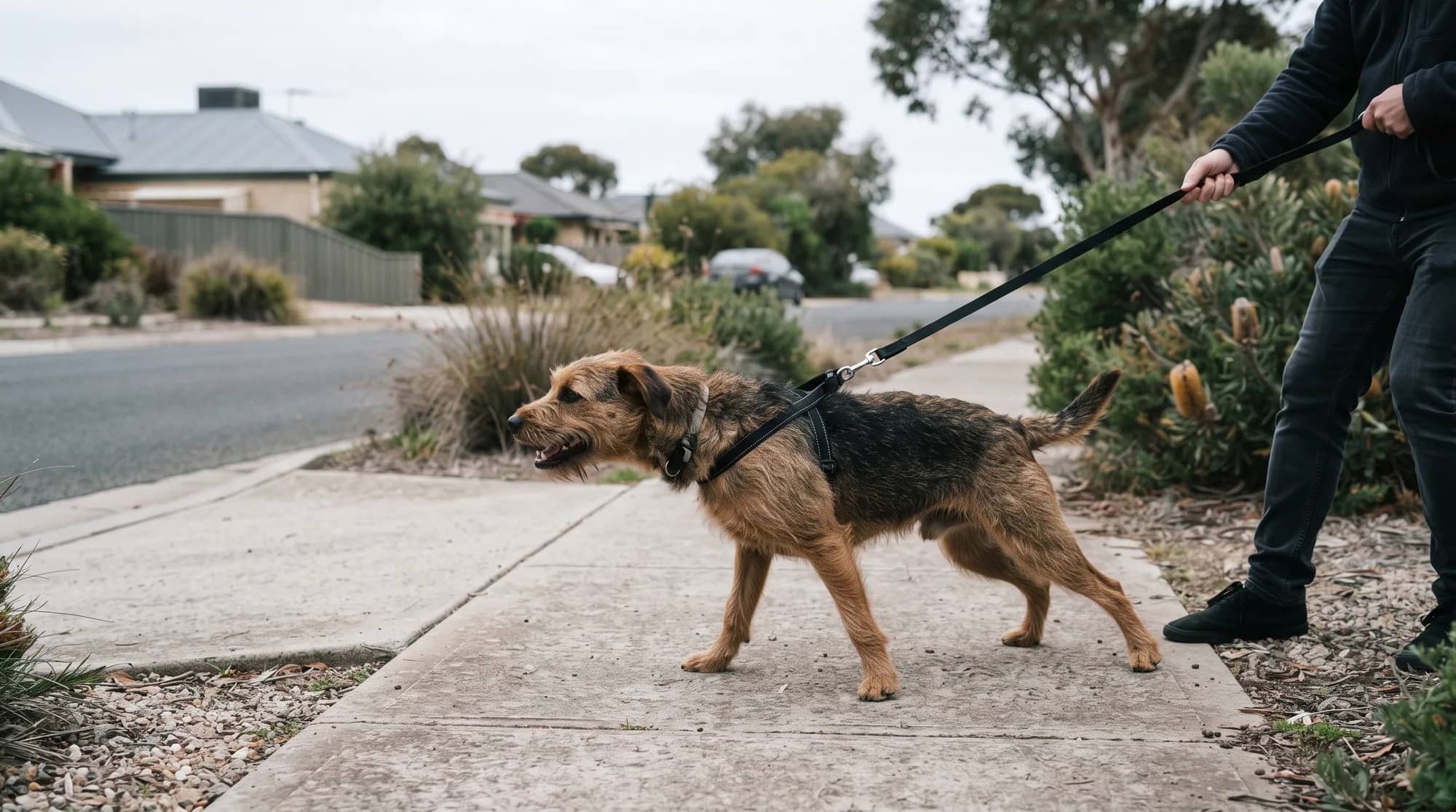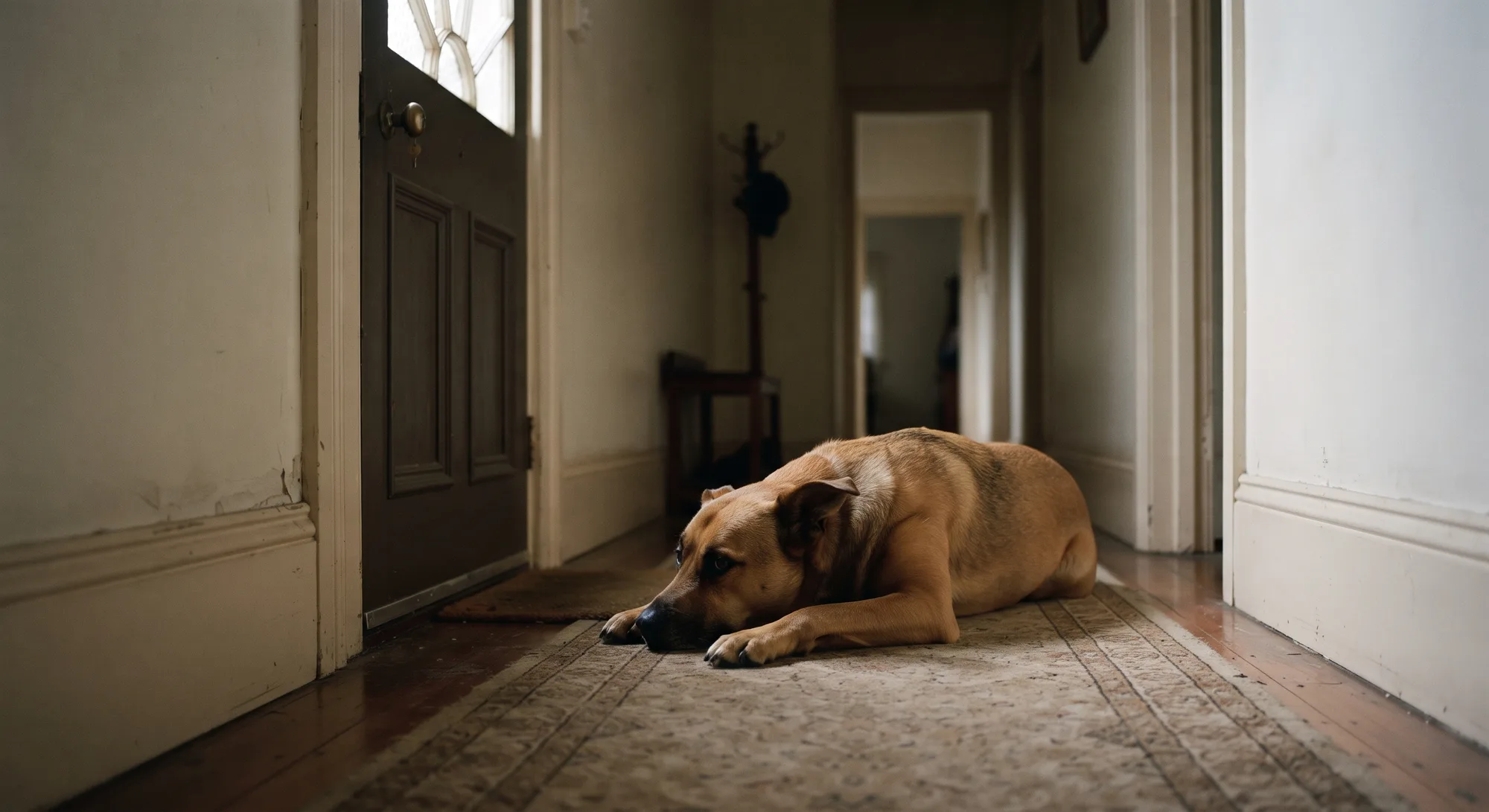
Four completely different problems produce the same chewed door frame.
Separation anxiety, boredom, noise phobia, and a dog that was simply never taught to be alone. They look nearly identical when you walk in the door, they need entirely different plans, and picking the wrong one costs you months.
Thirty minutes of phone footage will tell you which one you have. Genuinely — set a phone on a shelf pointing at the door before you leave tomorrow. It is the single most useful thing you can do.
What the footage tells you
Separation anxiety
Timing: starts fast. Usually within the first five to twenty minutes, often before you have reached the end of the street.
Target: exit points. The front door, the door frame, window sills, blinds, the door to the room you left through. Sometimes the dog's own paws and nails, which is where you get the blood.
Body: pacing, panting, drooling, whining escalating to howling or screaming. A dog that is genuinely distressed, not a dog having fun.
Food: refused. A dog in a panic state will not eat, which is one of the cleanest tests there is. Leave a stuffed food toy — if it is untouched forty minutes later, that tells you a lot.
Toileting: may toilet indoors despite being reliably house-trained for years.
Boredom
Timing: starts much later. An hour in, two hours in, or in a burst mid-afternoon.
Target: whatever is interesting. The couch, shoes, the bin, a cushion. Not specifically the exits.
Body: relaxed between episodes. The dog sleeps, wakes, finds something to do, sleeps again.
Food: eaten immediately, usually before you have left the driveway.
Noise phobia
Timing: correlates with an event, not with your departure. Storms, fireworks, bin trucks, construction.
The giveaway: it happens on some days and not others, and it happens whether or not you are home — though you may not have noticed the milder version while you were there.
Never taught to be alone
Timing: starts at departure, like anxiety.
But: it is milder, it settles after ten or fifteen minutes, and it is largely vocal rather than destructive. There is distress but not panic.
This one is genuinely good news, because it is a training gap rather than a clinical anxiety case, and it resolves far faster.
Why it matters so much
Because the treatments contradict each other.
For boredom, more exercise, more enrichment and a busier day are the answer.
For separation anxiety, exercise helps at the margins but the core problem is a panic response, and a tired dog can panic perfectly well. Owners who try to solve genuine separation anxiety with longer walks end up with a fitter dog that still destroys the door.
And the classic advice for both — "just ignore it, they'll get over it" — is actively harmful for anxiety. That is flooding. Leaving a panicking animal in the panic state for eight hours a day does not habituate it. It sensitises it.
What separation anxiety actually is
It is a panic response. Closer to a panic attack than to misbehaviour.
Which means two things follow immediately.
It does not respond to correction. You cannot punish a dog out of panic, and attempting it adds fear to fear. This is why bark collars are such a bad idea for this particular problem — you are penalising an animal for the noise it makes while terrified.
And your dog is not doing it to punish you. Every owner half-wonders whether it is spite. It never is. Dogs do not do spite. They do panic, and panic looks like a targeted attack on your back door.
The bit people find counterintuitive
Before any training starts, you have to stop your dog rehearsing the panic.
Every day your dog spends eight hours in distress is a day of practice at being distressed, and no amount of graduated departure training out-runs that. It is like trying to heal a wound you reopen every morning.
So step one is logistics, not technique. Whatever it takes to break up the long stretches:
- A neighbour or friend who can sit in
- Daycare two or three days a week
- A dog walker at the midpoint
- Adjusted hours, if your work allows any flexibility
- Taking the dog with you where that is possible
It is inconvenient and sometimes expensive. It is also the difference between this taking two months and taking a year.
The training
Defuse the departure routine first
Your dog started spiralling when you picked up your keys, not when you shut the door. Shoes, keys, that particular bag, the way you say goodbye — those cues have become reliable predictors of something terrible.
So make them meaningless. Pick up the keys and sit down. Put your shoes on and make a cup of tea. Grab the bag and put it back. Forty times a day, for a week or two, until none of it means anything.
This alone often produces a visible improvement inside a fortnight, and it makes everything downstream easier.
Then build duration from genuinely zero
Not "leave for five minutes and build up". For a severe case, zero might be you standing on the other side of the closed door for three seconds.
Then five. Then ten. Then out the door and back. Then thirty seconds. Lots of repetitions at each stage, and — crucially — never going past the point where your dog starts to worry. If you come back to a distressed dog, you went too far, and you have just done a repetition of panic.
This is slow and it is boring and it is the only approach with a decent track record.
Expect the curve, not the line
The first ten minutes are the hardest and take the longest. Once a dog can genuinely do twenty minutes without distress, thirty and forty tend to come much faster, because the underlying rule has been learned: you leave, you come back, nothing bad happens in between.
Expect setbacks
A storm, a change in routine, a holiday, leaving in an unusual way — any of these can knock you back a stage. That is normal. Drop to a duration your dog can do, rebuild, and it comes back quicker each time.
Things that do not work
Getting a second dog. Most separation anxiety is about being separated from you, not about being alone. If it does not work — and it frequently does not — you now have two dogs and one problem.
A bark collar. Punishing a panicking dog. Please do not.
Crating a dog that panics in a crate. For some dogs a crate is a safe den. For a dog with separation anxiety it can be a trap that escalates the panic and produces genuine injury. If your dog is worse in a crate, it is not the answer for this dog.
Tiring the dog out. Helps a bit. Does not treat the problem.
Medication
For moderate and severe cases this is a mainstream, well-evidenced part of treatment and not a last resort.
Your vet prescribes it, not me. What it does is lower the panic enough that the training can actually get traction — it works alongside behaviour modification, not instead of it. A dog too anxious to learn cannot be trained out of anxiety, which is the trap a lot of severe cases sit in.
If your case is severe, or if you have been working at it for months without progress, take it to your vet. There is no prize for doing this the hard way.
The neighbour problem
If you are in an apartment in Glenelg, a townhouse in Unley, or a close-set block in Morphett Vale, the noise reaches people. And a barking complaint attaches a deadline to a problem that inherently takes months.
Two things help. First, tell your neighbours what is going on and that you are working on it — silence is what makes complaints escalate. Second, prioritise the management side hard, because that is where the fast reduction is while the slow training happens.
Realistically
Genuine separation anxiety takes weeks to months. Anyone offering a fast fix is describing a different problem — probably the "never taught to be alone" version, which does resolve quickly.
Where most households land is a dog that can be left for a normal working day without distress, and a family that has stopped organising its entire life around who is home. That is achievable for the large majority of cases.
It just takes considerably longer than anybody wants it to.